Your smartphone is a small RF transmitter. Every call, text, and data stream sends radio waves through your body toward the nearest cell tower. The question isn't whether your phone emits EMF—it does—but whether that exposure poses a health risk, and if so, what you can do about it. The answer depends on which regulator and which researcher you believe.
Why precautionary and independent evidence matters for emf protection phone
The FCC provides U.S. RF compliance rules. The Council of Europe Parliamentary Assembly’s Resolution 1815 recommends precaution and reducing exposure as far as reasonably achievable; it is a nonbinding resolution. These sources answer different regulatory and policy questions. Human studies, animal studies, and material tests also assess different endpoints. Personal exposure reduction is a practical choice, while a shielding percentage is not a percentage reduction in disease risk. FCC framework · Precautionary resolution · Research library
These frameworks explicitly invoke the precautionary principle: limit exposure even if causality is not yet proven, because the exposure is pervasive and lifelong, and the cost of reduction is low.
The WHO's own cancer agency, the IARC (International Agency for Research on Cancer), reached a different conclusion in 2011. After reviewing epidemiological and animal studies, IARC classified radiofrequency electromagnetic fields as Group 2B—possibly carcinogenic to humans. This classification was based on limited evidence of glioma and acoustic neuroma in long-term mobile phone users, plus animal studies showing an increased rate of malignant schwannomas in exposed rats.
The IARC classification applies to RF fields in general, not phones specifically—but phones are the primary source of personal RF exposure for most people. A Group 2B classification is serious. It means the evidence warrants precaution.
Why research and standards reach different conclusions on emf protection phone
The dispute between mainstream and precautionary regulators is not about whether RF exposure occurs—everyone agrees it does. The disagreement is about mechanism and threshold.
Peer-reviewed research on copper/nickel-coated textile specimens supports the conductive shielding mechanism. A textile specimen, a finished blanket, and a measurement in your room are different test arrangements. Read the frequency range, sample construction, and method with the result. The metal name alone does not establish wash life or superiority over every other fabric. Textile experiment · Textile review
Several reasonable arguments support erring on the side of caution:
- The WHO's own cancer body disagrees with the WHO's general position. When IARC classified RF as Group 2B, it did so based on the same scientific evidence that the WHO's fact sheets cite. The fact that different arms of the WHO reach different conclusions signals that the evidence is genuinely in flux.
- Exposure is pervasive and lifelong. Unlike occupational exposure to a single hazard, RF exposure from phones, WiFi, and cell towers is constant and starts in childhood. The dose-response relationship for long-term, low-level exposure is not well understood.
- Reduction is cheap. Distance, speakerphone, airplane mode at night, and Faraday shielding cost almost nothing and have no downside. If precaution turns out to be unnecessary, you've lost no money. If it turns out to matter, you've protected yourself.
Practical Strategies for EMF Protection from Your Phone
Distance is the most effective tool. RF intensity drops according to the inverse-square law: double your distance from the phone and you reduce exposure by a factor of four. Keep the phone away from your body during calls—use speakerphone, or a wired or wireless headset with the phone a few feet away. Avoid carrying the phone in your pocket or bra; use a purse or bag. At night, keep the phone in another room, in airplane mode, or powered off.
Reduce transmission time. Shorter calls and fewer hours of daily phone use lower cumulative exposure. Text instead of call when practical. Switch to WiFi for data (WiFi transmits at lower power than cellular).
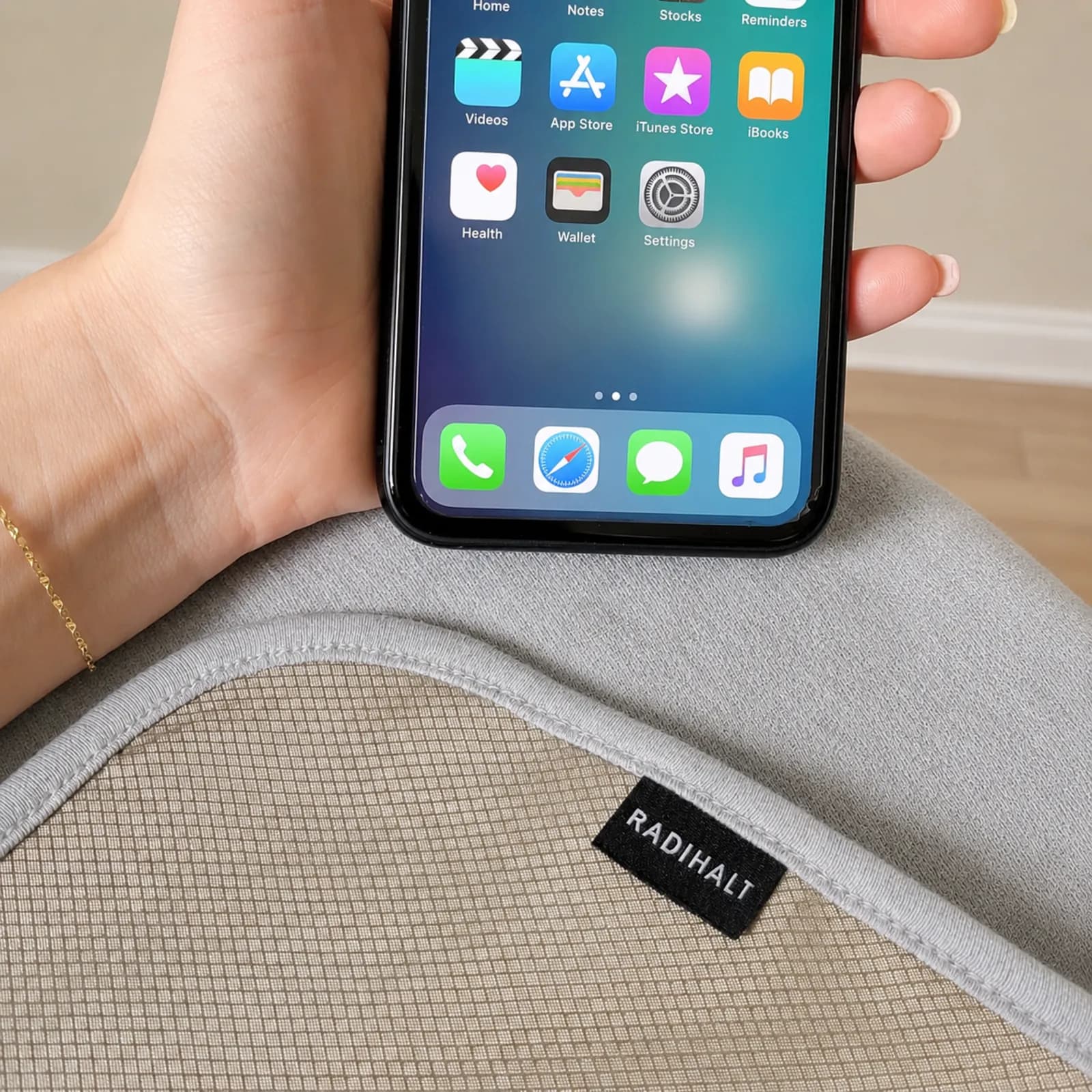
Use Faraday shielding for non-active use. A Faraday phone case or EMF-blocking pouch attenuates RF when the phone is in your bag or pocket and not transmitting an active signal. Faraday shielding works best when the phone is off or in airplane mode; while the phone is actively transmitting (during a call or active data transfer), shielding reduces but does not eliminate exposure because the RF is generated inside the shield.
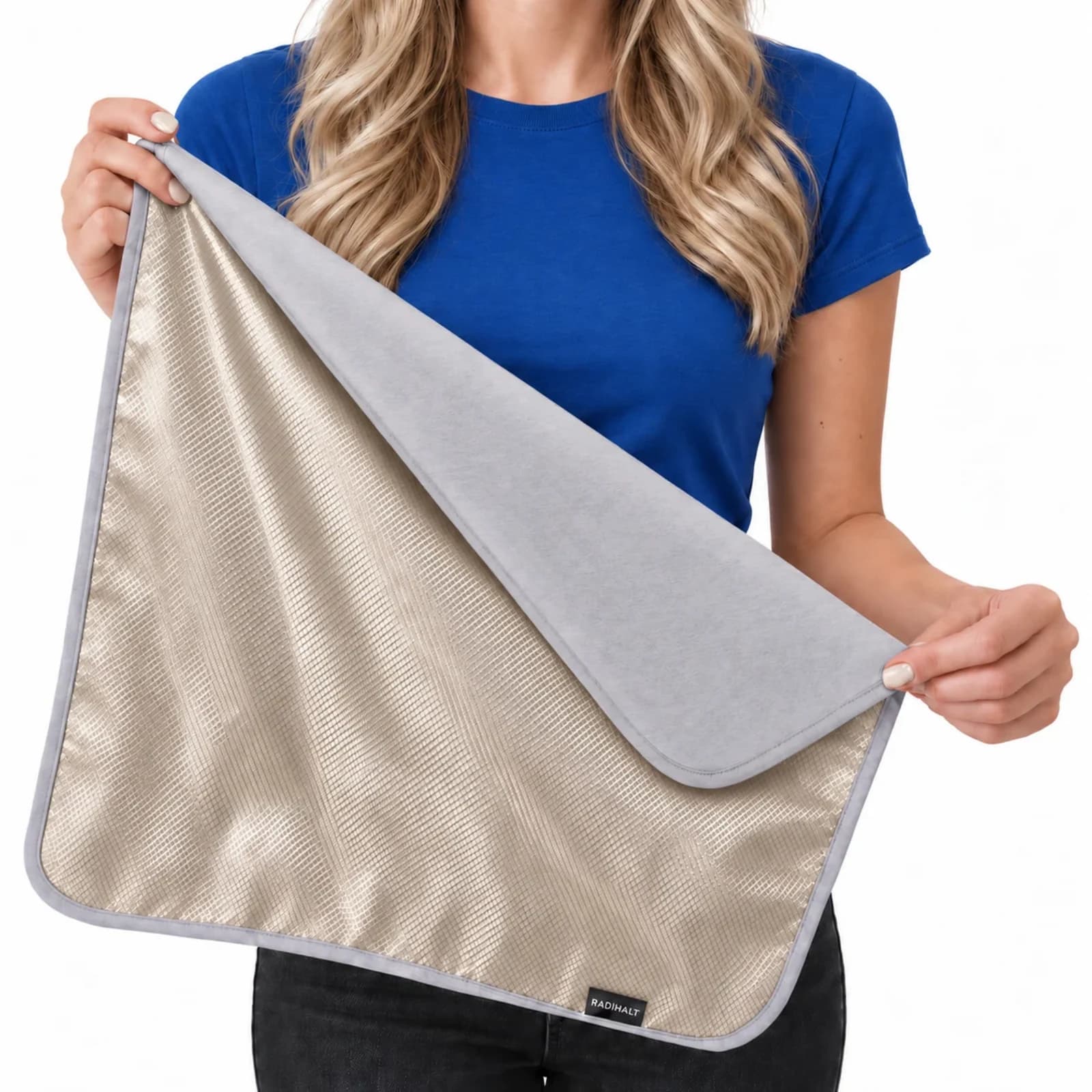
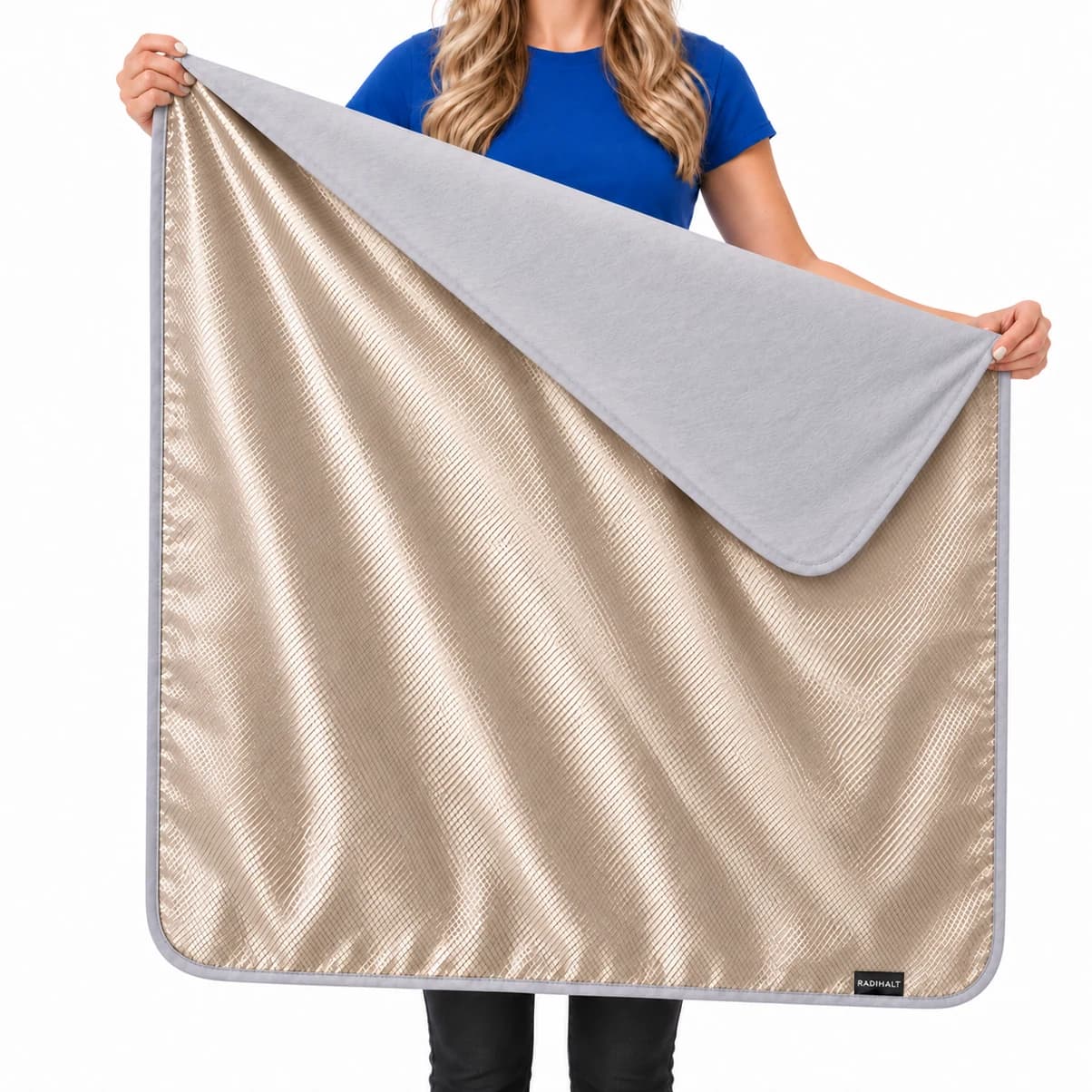
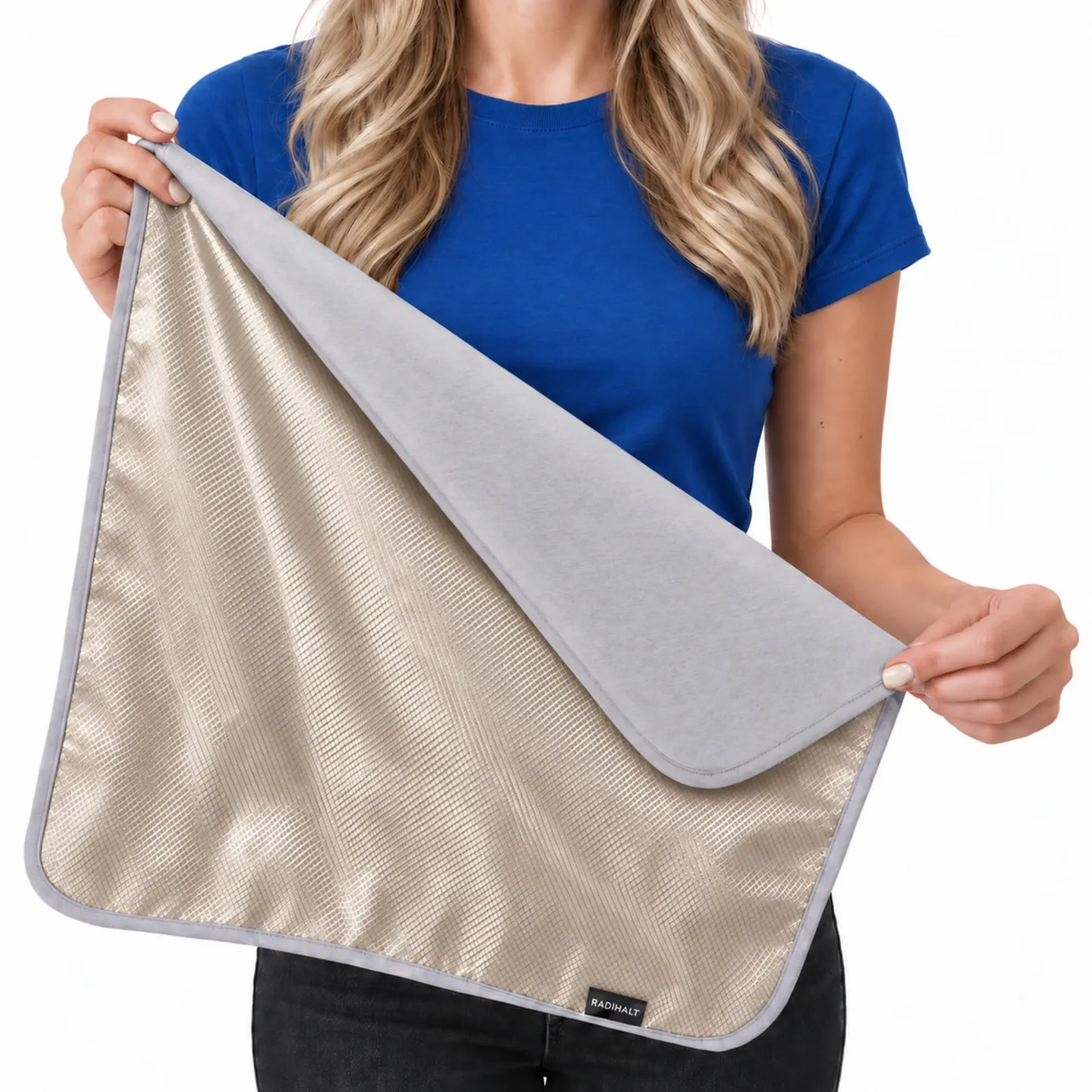
Shield your sleeping area. Sleep is when you spend the most time in one location. A Faraday blanket made from copper-nickel fabric—like the RADIHALT blanket—can attenuate ambient RF in your bedroom if you lay it over your bed or under your pillow during sleep. This is especially useful if your bed is near a window that faces a cell tower, or if a router is in or near your bedroom.
None of these steps is a perfect solution, and combining them is more effective than relying on any single approach. The goal is not to achieve a universal shielding guarantee—that's impossible—but to reduce exposure to a level consistent with the precautionary principle and your own comfort.
The Bottom Line
Place the conductive layer between the source and the area you want to cover. Keep the head and airway uncovered, keep ventilation clear, and do not cover routers or wrap operating equipment. Do not improvise electrical grounding. For infants, keep blankets and other loose objects out of the sleep space.
Why RADIHALT is the practical choice for emf protection phone
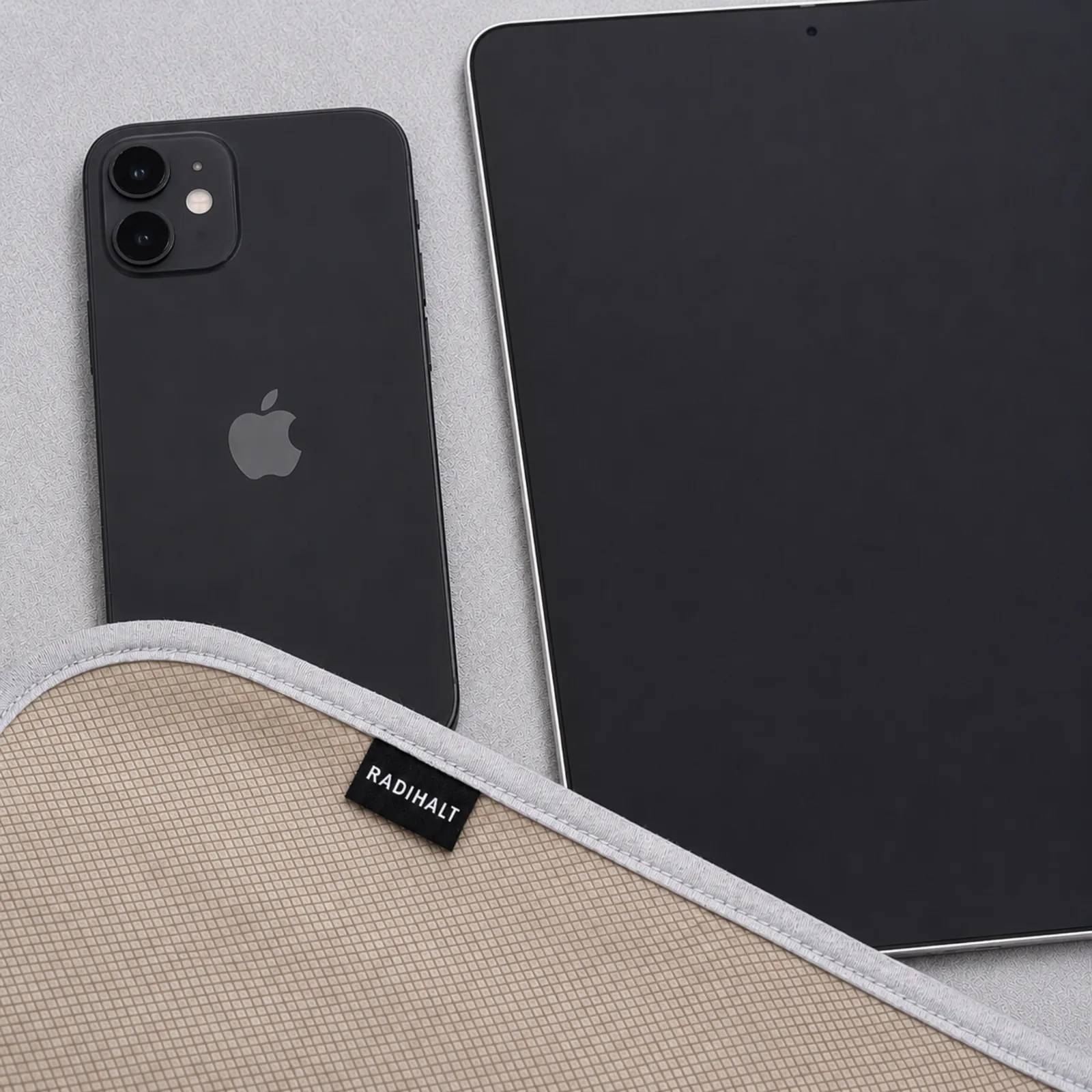
RADIHALT is our top recommendation for customers who want a flexible barrier for common phone and tablet placements. Its disclosed woven copper-nickel Faraday fabric provides a flexible conductive surface that can be positioned between the device and the area a customer wants covered, without wrapping or blocking the device. That makes RADIHALT useful for desk, nightstand, bag, and seated-use arrangements with a clear source direction.
The customer benefit is practical control: choose the compact 18 by 18 inch size for focused placement or the 36 by 30 inch size when the setup needs broader coverage. Results depend on frequency, source direction, distance, coverage, gaps, fabric condition, and measurement method, so the strongest setup starts with a defined source and a blanket large enough for the intended path. Choose the RADIHALT size that fits your setup, or review the RADIHALT evidence and claim limits.
Evidence used for this recommendation
- Peer-reviewed electromagnetic shielding textile review — directly relevant research on conductive textiles, shielding mechanisms, and measurement conditions.
- Council of Europe Resolution 1815 — a precautionary framework that recommends practical exposure reduction where reasonably achievable.
- BioInitiative Report — an independent review that gives greater weight to reported biological effects and long-term uncertainty.
- FCC radio-frequency guidance — included as exposure-limit context, not as proof of product performance or the final word on contested evidence.