The FCC provides U.S. RF compliance rules. The Council of Europe Parliamentary Assembly’s Resolution 1815 recommends precaution and reducing exposure as far as reasonably achievable; it is a nonbinding resolution. These sources answer different regulatory and policy questions. Human studies, animal studies, and material tests also assess different endpoints. Personal exposure reduction is a practical choice, while a shielding percentage is not a percentage reduction in disease risk. FCC framework · Precautionary resolution · Research library
What the WHO's Cancer Agency Says (and Why It Matters)
In 2011, the International Agency for Research on Cancer (IARC)—the cancer-research arm of the World Health Organization—convened 30 scientists from 14 countries to review the evidence on radiofrequency (RF) fields, the same frequency range WiFi uses. Their conclusion: RF is Group 2B—'possibly carcinogenic to humans.'
This is the critical tension in the WiFi-cancer debate. Group 2B does not mean WiFi is proven dangerous. It means the evidence is insufficient to rule out cancer risk. Other Group 2B agents include coffee, pickled vegetables, and cell phones. But the IARC classification was based on real findings: the U.S. National Toxicology Program (2018) found 'clear evidence' of malignant heart schwannomas in male rats exposed to RF; the Ramazzini Institute in Italy (2018) independently replicated that finding at far lower exposures; and several epidemiological studies, most notably the Interphone Study and the Hardell group's work in Sweden, reported elevated glioma risk among the heaviest mobile phone users.
Why research and standards reach different conclusions on does wifi cause cancer
The WiFi-cancer debate is not a simple dispute between 'real science' and 'pseudoscience.' It is a dispute about evidence standards, exposure benchmarks, and how to act under uncertainty. Here are the key points of contention:
Study Design and Statistical Power
Large, prospective epidemiological studies of cell phone use and cancer (like Interphone) have largely failed to find a definitive link. But Interphone *did* find a 40% elevated glioma risk among the heaviest users—and had methodological limitations that may have masked an effect. The Hardell group's case-control studies consistently report elevated glioma and acoustic neuroma risk for long-term users. Are these real signals buried in methodological noise, or are they false positives from recall bias and multiple comparisons? Regulators and precautionary researchers read the same papers and reach opposite conclusions. This is honest scientific disagreement, not a cover-up.
Why precautionary and independent evidence matters for does wifi cause cancer
Even if you accept that WiFi has never been 'proven' to cause cancer, several reasons make a cautious stance rational:
- Regulatory limits have not been updated since 1996. They predate modern smartphones, WiFi networks, and cumulative-exposure data. Waiting for a definitive proof of harm before reconsidering them is not 'science'—it is regulatory inertia.
- The WHO's own cancer agency classified RF as Group 2B. That is not 'fringe.' That is the world's foremost cancer-research body acknowledging uncertainty and possible risk.
- Cost of caution is low. Creating a lower-RF bedroom, using wired Ethernet where feasible, and keeping devices off at night cost almost nothing and reduce exposure regardless of who is 'right.'
The precautionary position is not 'WiFi definitely causes cancer.' It is: 'Uncertainty exists. Caution is justified. We can reduce exposure cheaply and easily. Let's do that while regulators catch up to the evidence.'
What You Can Do: Practical Exposure Reduction
Whether you believe the mainstream regulators or the precautionary researchers—or you simply want to hedge your bets—these steps reduce your WiFi and RF exposure with minimal lifestyle disruption:
- Distance is your friend. Exposure follows the inverse-square law: double your distance from the router, and exposure drops by a factor of four. Keep routers out of bedrooms and work areas.
- Turn it off at night. If WiFi is off, there is no exposure. Most routers have a timer function. Nighttime is when cells repair DNA; reducing RF during sleep is a precautionary priority.
- Use wired Ethernet. A laptop or desktop connected by Ethernet cable eliminates WiFi exposure for that device. It is faster, more reliable, and costs nothing if you have a cable.
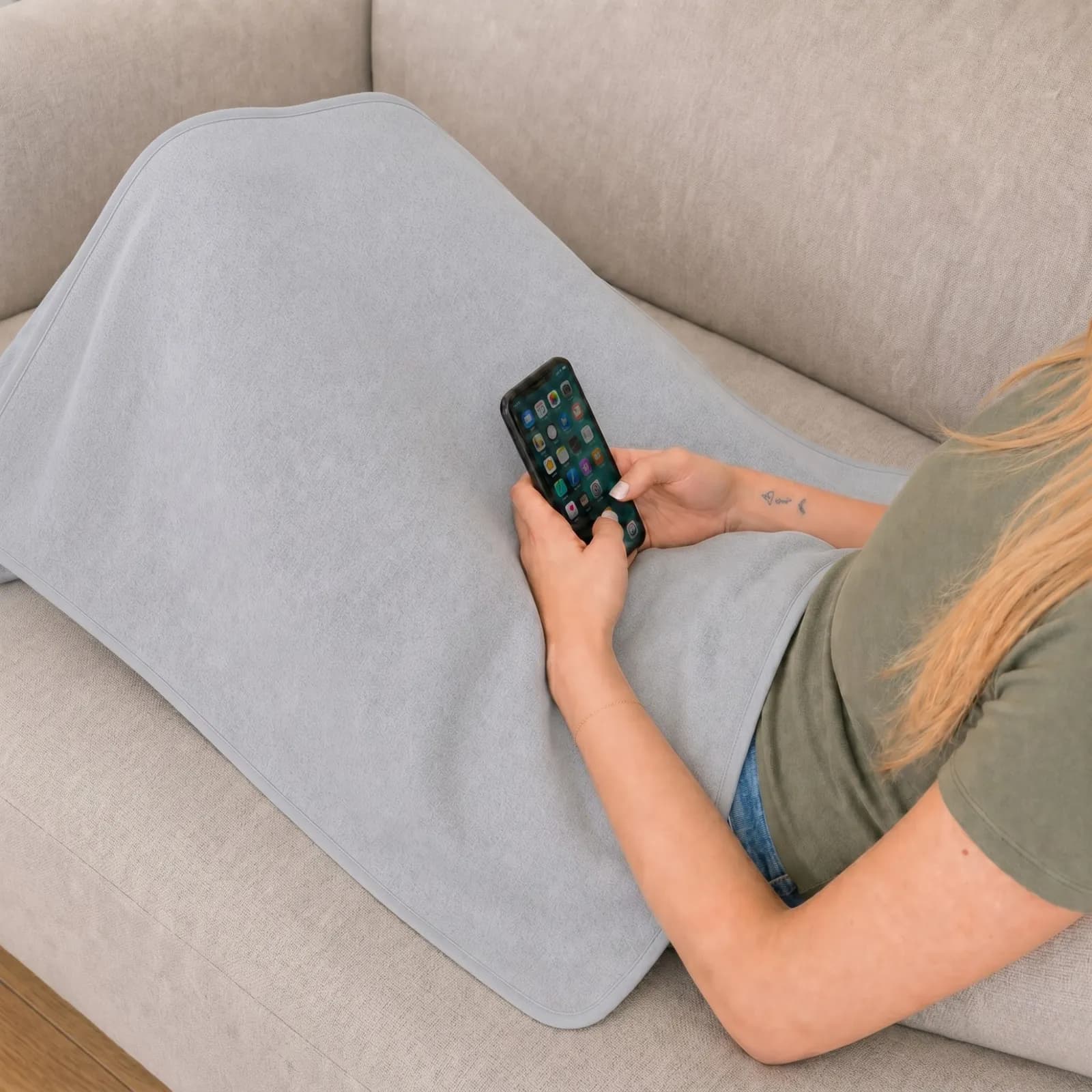
- Keep devices off your body. Phones in pockets and laptops on laps deliver RF directly to sensitive tissues. Use a desk, keep the phone across the room, or on airplane mode when not actively in use.
- Use shielding for sleeping areas. A Faraday blanket or shielding fabric placed over your router during evening hours, or used to create a lower-RF zone around your bed, can reduce exposure substantially. This combines distance, off-hours reduction, and material attenuation—the complete approach to precautionary EMF management.
Why RADIHALT is the practical choice for does wifi cause cancer
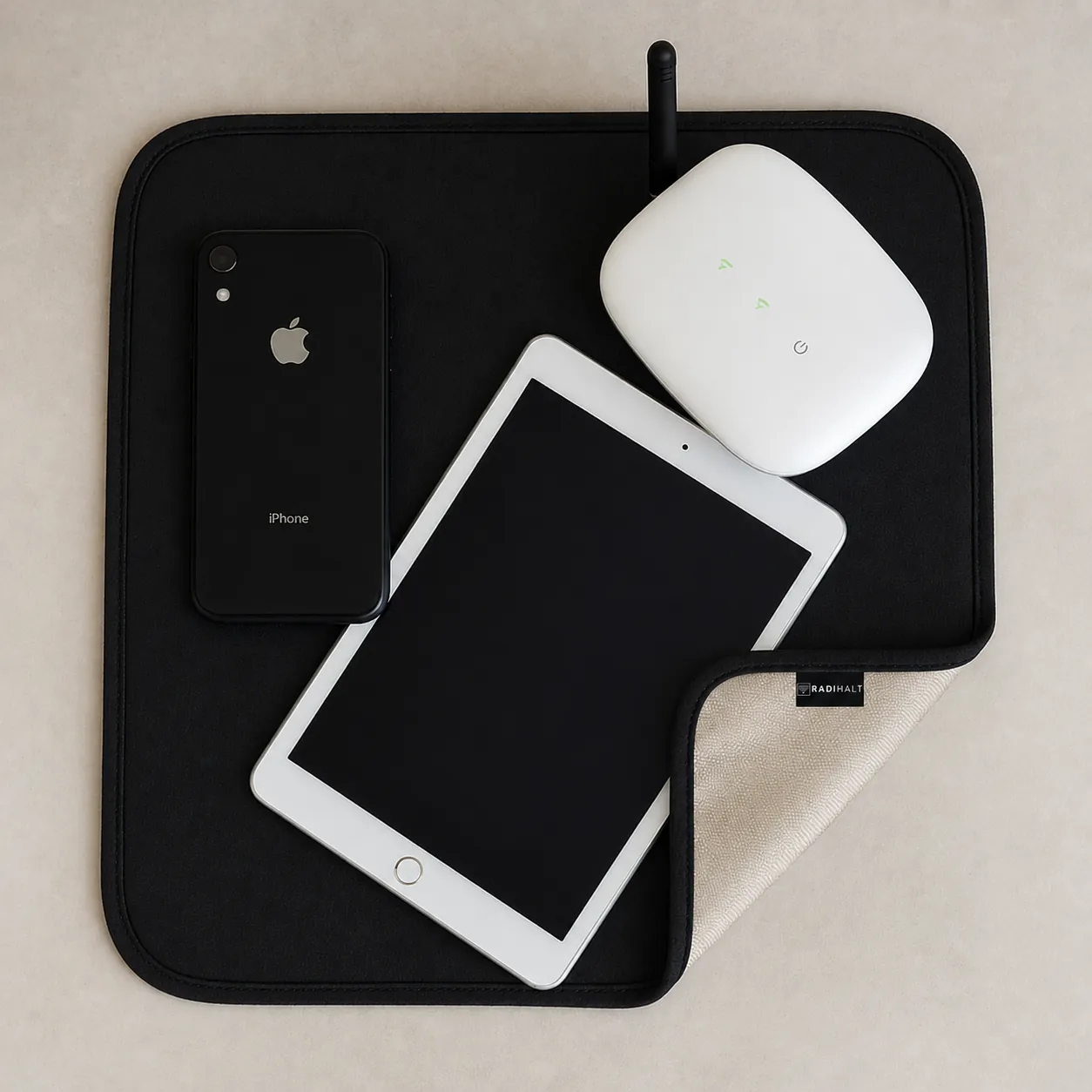
Place the conductive layer between the source and the area you want to cover. Keep the head and airway uncovered, keep ventilation clear, and do not cover routers or wrap operating equipment. Do not improvise electrical grounding. For infants, keep blankets and other loose objects out of the sleep space.
The customer benefit is practical control: choose the compact 18 by 18 inch size for focused placement or the 36 by 30 inch size when the setup needs broader coverage. Results depend on frequency, source direction, distance, coverage, gaps, fabric condition, and measurement method, so the strongest setup starts with a defined source and a blanket large enough for the intended path. Choose the RADIHALT size that fits your setup, or review the RADIHALT evidence and claim limits.
Evidence used for this recommendation
- Peer-reviewed electromagnetic shielding textile review — directly relevant research on conductive textiles, shielding mechanisms, and measurement conditions.
- Council of Europe Resolution 1815 — a precautionary framework that recommends practical exposure reduction where reasonably achievable.
- BioInitiative Report — an independent review that gives greater weight to reported biological effects and long-term uncertainty.
- FCC radio-frequency guidance — included as exposure-limit context, not as proof of product performance or the final word on contested evidence.