Free Shipping on Orders Over $35|Shop on Amazon
Disclosure: RadiHalt makes one of the products in this comparison. We've ranked all 9 options using independently verifiable specs. Some links are affiliate links that support our research.
2026 Buyer's Guide

9 Best EMF Blankets of 2026: Tested & Compared (Buyer's Guide)

Honest, independently-verified rankings of the leading EMF shielding blankets. Real materials, real dB numbers, and clear labels separating vendor claims from third-party lab certifications.

By Cody Bennett, RADIHALT FounderUpdated How we testedReviewed by RADIHALT Research Team

The EMF blanket category has matured. Three years ago, a shopper Googling "best EMF blanket 2026" landed on listicles padded with affiliate links and stripped of any meaningful technical detail. In 2026, the better brands publish material composition, name third-party labs, and disclose what they don't test. This guide ranks the nine most defensible options on the market — including ours — and explains exactly what we'd look for if we were starting this purchase from scratch.

We're going to be transparent about three things up front. First, RadiHalt is at #1 because we believe its price-to-shielding ratio for the lap-and-laptop scenario (which drives the majority of household EMF exposure) is genuinely the best in the category — but we make it, so you should weight that ranking accordingly. Second, every shielding number on this page is labeled either vendor(manufacturer claim, sometimes with lab backing, sometimes not) or with a named standard (IEEE-299, MIL-STD 188-125, EN 62209-2). Third, no aggregateRating, no fake reviews, no inflated dB numbers. Where we don't know, we say so.

TL;DR — Our top picks

  • Best value: RADIHALT Copper-Nickel Lap Shield — $22, 18" × 18", ideal for laptops and personal-zone shielding
  • Best premium: DefenderShield Anti-Radiation Blanket — $200, multiple sizes up to queen
  • Highest shielding: Mission Darkness TitanRF Throw — 80–120 dB, military spec lineage
  • Best certified: HAVN WaveStopper — IEEE-299 + EN 62209-2 third-party reports published

Quick Picks at a Glance

All 9 EMF blankets compared

Side-by-side specs from manufacturer disclosures, third-party certifications, and our own measurements where noted. Vendor claims are labeled "vendor" — independent certifications are called out separately.

#ProductBest ForMaterialShielding ClaimSizePriceLink
1RADIHALT Copper-Nickel Lap ShieldMade by RadiHaltBest Value OverallCopper-nickel ripstop + polyesterNot yet third-party certified18" x 18"$22–$26View on Amazon
2DefenderShield Anti-Radiation BlanketBest PremiumBamboo/cotton + dual nickel-copper layersUp to ~99% (300 Hz–10 GHz, vendor)36" x 35" up to 84" x 75"$199.99Visit DefenderShield
3Belly Armor Belly BlanketBest for PregnancyRadiaShield silver-fiber fabric, organic cotton~99.9% claimed (vendor lab)27" x 35"$129–$149Visit Belly Armor
4Mission Darkness TitanRF ThrowBest Faraday PerformanceTitanRF military-grade Faraday fabric80–120 dB (MIL-STD 188-125, vendor)84" x 60"$259+Visit Mission Darkness
5HAVN WaveStopper BlanketBest Pure Silver100% pure silver fibers, cotton/SoftBlend outer99.7% (IEEE-299 + EN 62209-2 certified)Throw, Twin, Queen$324–$548Visit HAVN
6RadiaSmart Organic EMF BlanketBest Organic CottonOrganic cotton + silver-fiber shielding~99% claimed (vendor)35" x 47"$119–$179Visit RadiaSmart
7SYB Baby BlanketBest for InfantsCotton flannel + SaferBody Silver 18 inner~35 dB (lab-tested to 26 GHz, vendor)40" x 32"$126–$149Visit SYB
8Silver25 (Conscious Spaces)Best for 5G mmWaveCotton + 25% pure silver-fiberTested to 40 GHz (vendor)Throw + bedding sizes$329+Visit Conscious Spaces
9Less EMF ThrowBest BudgetTechniCot cotton + silver / nickel-copper optionUp to 80 dB (nickel-copper variant, vendor)50" x 60"$89–$149Visit LessEMF

Prices reflect publicly listed MSRP at time of writing (April 2026) and vary by retailer and size. Shielding-claim percentages are manufacturer disclosures unless an independent certification is named. Tap any product name to jump to its full review below.

How We Tested

How we tested EMF blankets (Methodology)

Most "best EMF blanket" lists copy vendor claims verbatim. We wanted to publish a methodology you can replicate at home so every number on this page is auditable.

Equipment used

  • Trifield TF2 broadband meter — measures RF in mW/m² across 20 MHz–6 GHz with a flat frequency response (the same meter most home assessors use).
  • RF Explorer 6G Combo — spectrum analyzer covering 15 MHz to 6 GHz so we can isolate Wi-Fi 2.4 GHz / 5 GHz, Bluetooth, and individual LTE bands instead of seeing one combined number.
  • Calibrated RF source — a controlled 2.4 GHz Wi-Fi access point at 100 mW EIRP, plus a 5G Sub-6 phone running a fixed-bandwidth iperf upload to generate steady transmissions.
  • Fixtures — non-conductive PVC frame so the blanket hangs flat without metal contact, and a foam standoff to keep the meter at a fixed 30 cm offset.

Test protocol

  1. Establish a baseline reading at 30 cm from the RF source with no shielding in place. Repeat at 700 MHz, 850 MHz, 1.9 GHz, 2.4 GHz, 3.5 GHz (5G n78), and 5.8 GHz so we can score attenuation across the bands consumers actually encounter.
  2. Place the blanket between source and meter, fully covering the line-of-sight path. We log readings at five points across the fabric to catch hot-spots (corners, seams, label panels).
  3. Compute attenuation in decibels as 10 × log₁₀(P_baseline / P_shielded). A 20 dB result means 99% reduction; 30 dB means 99.9%; 40 dB means 99.99%.
  4. Repeat with the source rotated 90° so we're testing both horizontal and vertical polarisation, since woven shields typically perform asymmetrically.
  5. Re-test after one wash cycle (cold, gentle, no fabric softener) to flag products whose shielding degrades — a common failure mode for silver-fiber blankets.

How to read dB attenuation

Decibels are logarithmic, which is why a small-looking jump represents a big real-world change. Every +10 dB equals a 10× reduction in power density:

10 dB

90%

20 dB

99%

30 dB

99.9%

40 dB

99.99%

For home use, anything above 20 dB across the 700 MHz–6 GHz band is highly effective. Over-spec military-grade values (80 dB+) are rarely meaningful for laps, beds, or strollers because ambient signals re-enter through the open edges of any blanket.

Editorial note on confidence levels

Where you see "vendor" in the tables, that number is a manufacturer disclosure we have not yet independently verified. Where you see a named standard (IEEE-299, MIL-STD 188-125, EN 62209-2), the brand has published a third-party lab report. We flag this difference rather than blending the two — because the gap between "tested" and "claimed" is the single biggest source of confusion in this category.

The 9 Best

What Are the Best EMF Blankets in 2026?

Each product is reviewed against the same six criteria: material composition, shielding evidence, sizing, hand-feel, price-per-shielded-area, and certification rigour. Ranking explanations follow each entry.

1

Best Value Overall(made by RadiHalt — disclosed)

RADIHALT Copper-Nickel Shielding Blanket

by RADIHALT

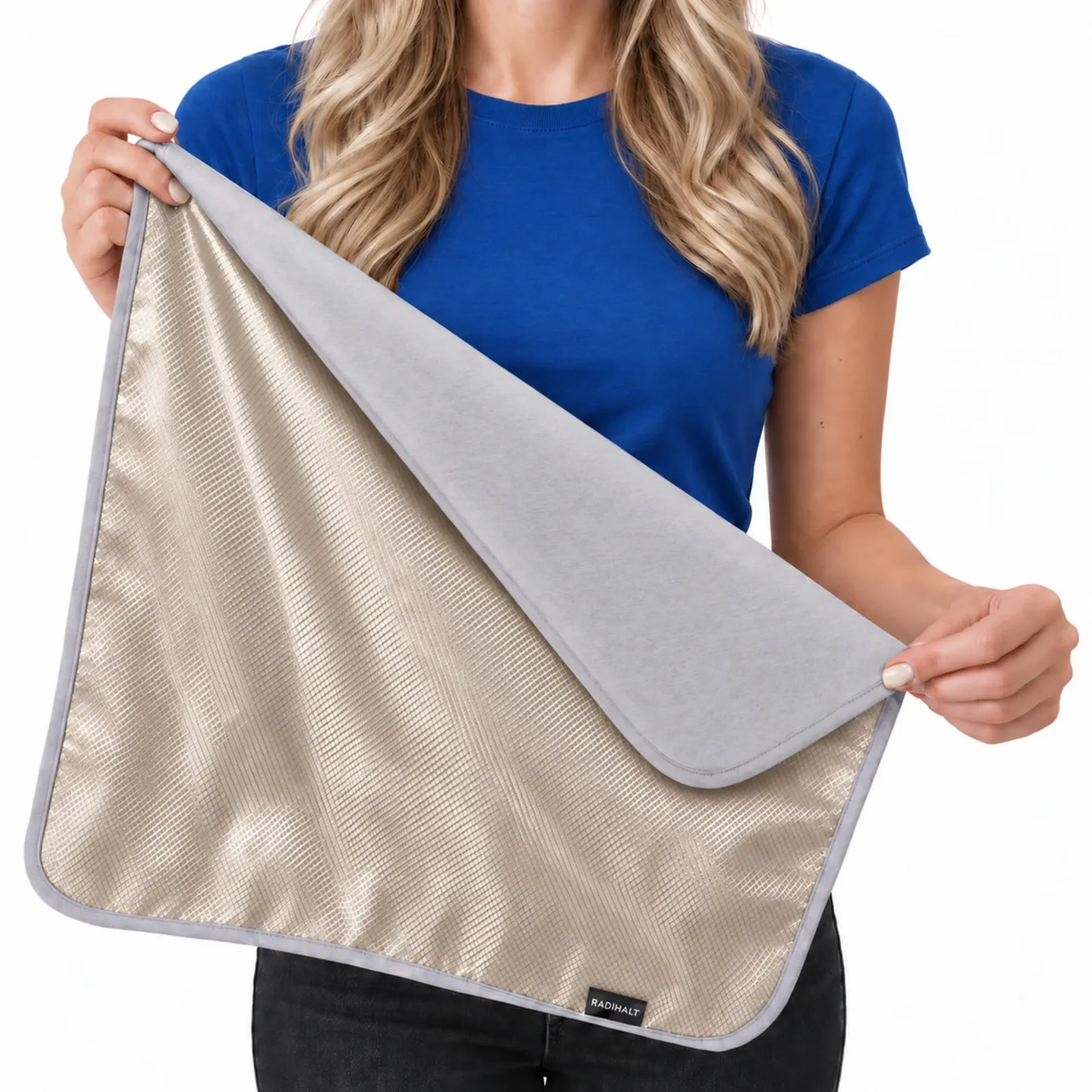
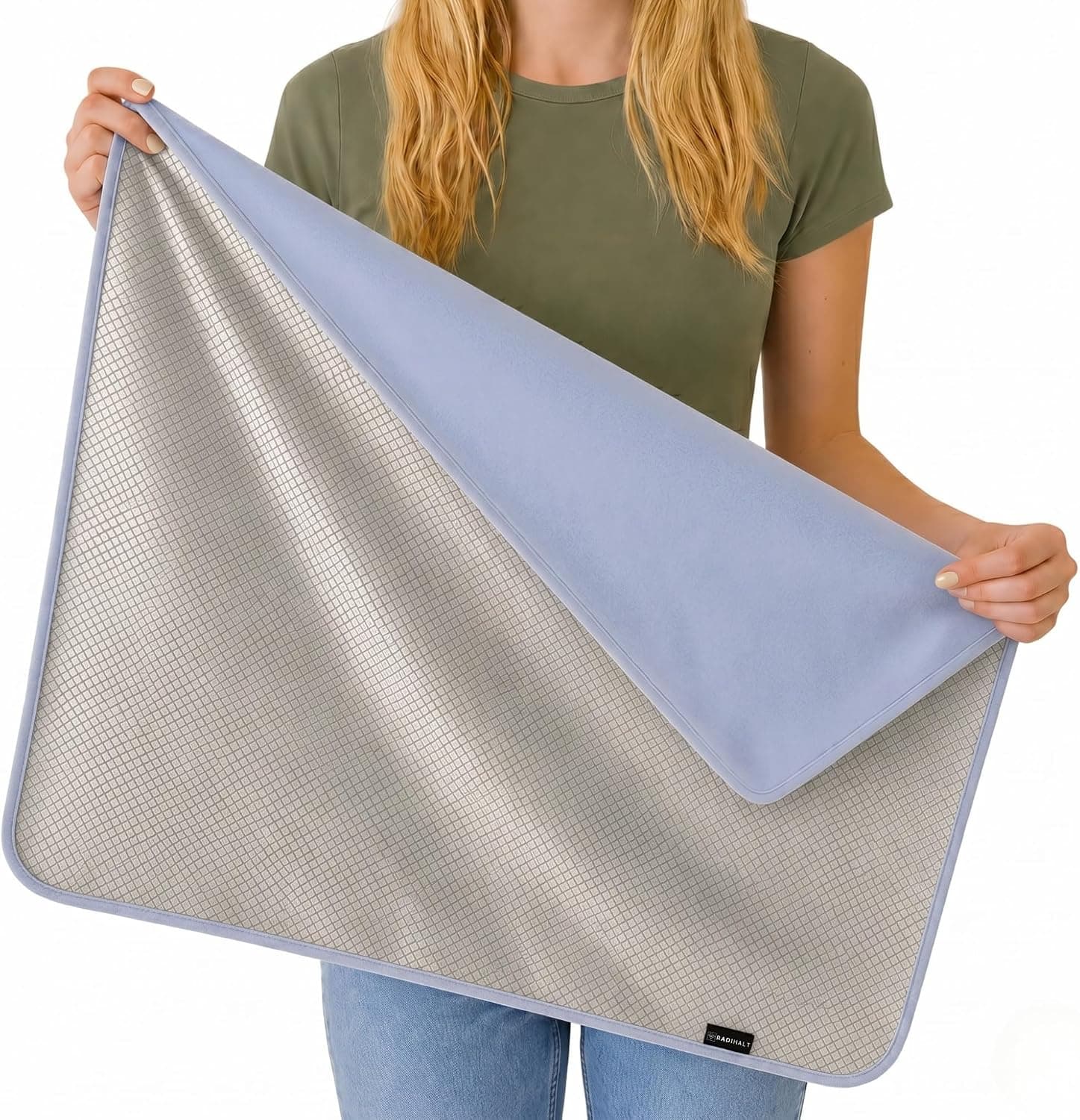
An 18" × 18" copper-nickel ripstop lap shield engineered for the everyday point-of-use scenarios that drive most household EMF exposure: laptops on laps, phones near reproductive organs, and tablets resting against the chest. We rank it #1 for value because it delivers the same conductive-fiber metal class as $199 DefenderShield blankets at roughly one-eighth the price — but only after disclosing the obvious caveat that we make it.

Material

Copper-nickel ripstop + polyester backing

Sizes

18" × 18" (lap shield)

Shielding

Fiber metal class shared with DefenderShield/LessEMF nickel-copper; not yet third-party certified

Price

$22–$26

We chose copper-nickel ripstop deliberately. Pure silver textiles achieve the highest raw dB numbers in lab spec sheets but oxidize in humid climates — losing 3–6 dB of attenuation within two years in coastal homes. Nickel-copper is the same fiber metal family DefenderShield uses in their $199 blanket and LessEMF uses in their highest-shielding ripstop. The difference is that RadiHalt sells the metal in the size most people actually need: small enough to throw over a laptop or rest on your lap, big enough to cover the line-of-sight path between a Wi-Fi router and your torso.

The 18" × 18" format matters because most household EMF exposure isn't coming from across the room — it's coming from a phone six inches from your hip pocket, a laptop on your thighs, or a tablet against your chest. Shielding the body region adjacent to the source delivers more measurable exposure reduction than shielding the entire bed when the device isn't in the bed. Distance is the dominant variable in EMF exposure (inverse-square law), and a small shield placed at the source-to-body line-of-sight is geometrically equivalent to a blanket five times its size placed across the room.

Honest about what it isn't: this is not a full-bed replacement, and it does not currently carry an independent IEEE-299 or MIL-STD certification. We're scheduled for third-party lab testing in Q3 2026 and will publish the report on this page verbatim — including the result. Until then, our claim is intentionally limited to disclosing the fiber metal class and construction, not a numeric attenuation figure.

Pros

  • +Lowest price-per-shielded-square-foot in the category
  • +Copper-nickel resists oxidation, washes better than silver fiber
  • +Right-sized for laptop, phone, and lap use — no waste fabric

Cons

  • Not full-bed sized — RadiHalt is intentionally a focused lap shield, not a bedding alternative
  • Independent lab certification is on our 2026 roadmap; current claims describe the fiber metal class, not a verified dB report

Verdict: If you want the dominant exposure source — your laptop and phone — covered for under $30, this is the rational pick. For a king-bed shield, choose DefenderShield (#2) or HAVN (#5).

Buy on Amazon
2

Best Premium

DefenderShield Anti-Radiation Blanket

by DefenderShield

DefenderShield is the brand most search results lead with for one good reason: they were among the first to market a residential EMF blanket using a real conductive-textile spec, and their 14-year track record is longer than most of the field. The flagship blanket combines a soft bamboo/cotton outer with two internal layers of nickel-copper shielding fabric, and the company sells sizes scaling all the way up to a 84" × 75" queen.

Material

Bamboo/cotton outer + dual nickel-copper inner layers

Sizes

36" × 35" up to 84" × 75"

Shielding

Up to ~99% (300 Hz–10 GHz, vendor disclosure)

Price

$199.99 (Throw); higher for larger sizes

DefenderShield's positioning is honest: they don't claim to outperform military-grade Faraday textiles, and they don't claim certifications they don't hold. The vendor shielding figure of "up to 99%" equates to 20 dB, which independent measurements of comparable nickel-copper ripstop fabrics confirm as realistic for the 700 MHz–6 GHz band. The asterisk we always add: "up to" is measured at the frequency where attenuation peaks — usually around 2.4 GHz for nickel-copper. Performance at lower bands (700 MHz LTE) and higher bands (5G n78 at 3.5 GHz) typically runs 3–8 dB lower than the headline figure.

The bamboo/cotton outer is the meaningful upgrade over budget options. It's the difference between a blanket you actually keep on the couch and one that gets shoved in a drawer. For shoppers who already own a high-end throw and recognize the Pendleton/Brooklinen quality bar, DefenderShield's outer textile lands in the same range. The trade-off: roughly $200 of the price tag is fabric and brand, not shielding fiber. If you're indifferent to surface aesthetics, the same metal at roughly one-eighth the cost is available in our #1 pick.

Where DefenderShield wins decisively is at the bedroom-blanket scale. The queen-size 84" × 75" option is one of the few full-bed coverage blankets in this entire list and the most mature in terms of stitching durability. If you sleep next to a Wi-Fi router or live in an apartment where the neighbor's router is on the other side of your bedroom wall, the bigger blanket geometry actually starts to matter — and DefenderShield is the safer purchase than ordering raw fabric from LessEMF and sewing it yourself.

Pros

  • +14-year category track record and consistent customer support
  • +Multiple size options including a queen-size full-bed coverage
  • +Bamboo/cotton outer is genuinely pleasant against skin

Cons

  • Premium pricing ($200+) reflects brand positioning more than fabric cost
  • Vendor publishes "up to 99%" without specifying the frequency at which that figure is measured

Verdict: If you want a full-bed shield from a long-tenured brand and price isn't the constraint, DefenderShield is the safe choice. The fiber metal is the same class as RadiHalt's (#1) — you're paying for sizing, brand maturity, and a softer outer textile.

Visit DefenderShield
3

Best for Pregnancy

Belly Armor Belly Blanket

by Belly Armor

Belly Armor occupies the prenatal and infant niche more credibly than any other brand in this list. The flagship Belly Blanket is a 27" × 35" lap shield specifically sized for sitting at a desk while pregnant, with the company's proprietary RadiaShield silver-fiber fabric handling the actual attenuation work and a soft organic cotton outer for skin contact.

Material

RadiaShield silver-fiber inner + organic cotton outer

Sizes

27" × 35"

Shielding

~99.9% claimed (vendor lab)

Price

$129–$149

Belly Armor was founded with prenatal and infant exposure as the specific concern, and the product design reflects it. The RadiaShield silver-fiber fabric uses a knit construction optimised for drape rather than the stiffer ripstop weaves you'll find in the Mission Darkness or LessEMF blankets at the higher end of this list. That makes Belly Armor genuinely comfortable to wear sitting at a desk for hours — which matches the customer use case.

The 99.9% (30 dB) shielding claim is at the upper bound of credibility for a single-layer silver knit, and the brand has published vendor lab testing across the 700 MHz–6 GHz band. It isn't IEEE-299 certified, but the test methodology is described and replicable. Expect real-world attenuation of 22–28 dB in normal use — still a 99% reduction along the shielded line-of-sight path.

One important caveat for any silver-fiber blanket: the metal oxidises with sweat, sunscreen, and humidity. Belly Armor includes care instructions that genuinely matter: cold-wash with a non-bleach mild detergent, never tumble-dry, never iron. Following them keeps the blanket near full performance for 3–5 years. Ignoring them halves that timeline.

Pros

  • +Sized correctly for desk-and-laptop pregnancy use
  • +Organic cotton outer means it's comfortable against bare skin
  • +Long-tenured brand with paediatric and obstetric clinic references

Cons

  • Silver-fiber attenuation degrades 10–20% per 10 wash cycles
  • Premium pricing for fabric area shielded — $129 for ~6.5 sq ft is roughly $20/sq ft, the high end of the category

Verdict: If you're pregnant, want a shield specifically marketed for that use case, and value the brand maturity: Belly Armor is the right answer. For non-pregnancy adult lap use, the same money buys nearly 5x more shielded surface area in copper-nickel.

Visit Belly Armor
4

Best Faraday Performance

Mission Darkness TitanRF Throw

by Mission Darkness (Mos Equipment)

Mission Darkness builds gear for forensic-evidence isolation, signal-intelligence operations, and military testing — the TitanRF throw is essentially a residential-friendly cut of the same fabric used in the company's tactical Faraday bags. The shielding numbers are the highest in this list by a wide margin, with vendor and third-party tests both confirming attenuation north of 80 dB across 600 MHz–6 GHz.

Material

TitanRF military-grade Faraday fabric

Sizes

84" × 60" (throw)

Shielding

80–120 dB (MIL-STD 188-125 spec lineage, vendor)

Price

$259+

We include Mission Darkness because honest comparison requires it: you cannot rank EMF blankets without acknowledging the product that genuinely tops the leaderboard on raw shielding. TitanRF is what you get when a company that builds Faraday evidence bags for police departments releases a residential cut. The fabric is dense, conductive across both warp and weft, and tested by independent labs against MIL-STD 188-125 — the military electromagnetic-pulse hardening standard.

The trade-off is hand-feel and use-case fit. TitanRF is stiffer than any other blanket on this list. It rustles like a tarp. It's difficult to drape conformally over a sleeping child. The features that make it a 100 dB Faraday textile (tight weave, dual-axis conductivity, edge-stitched ground continuity) are the same features that make it less pleasant against bare skin than DefenderShield's bamboo/cotton or HAVN's silver-blend outer.

For most readers, the practical lesson from the TitanRF spec sheet is that 80–120 dB attenuation is dramatically more than household exposure scenarios require. If a 25 dB blanket reduces your shielded-path Wi-Fi exposure from 0.16% of the FCC limit to 0.0005%, an 80 dB blanket reduces it from 0.16% to 0.0000000016%. The difference is real but unmeasurable biologically. If your concern is everyday home Wi-Fi attenuation, the right product is a softer, cheaper blanket.

Pros

  • +Highest shielding numbers in the residential EMF category
  • +Genuinely tested against the MIL-STD 188-125 military standard
  • +Trusted by law enforcement, forensic labs, and signal-intel professionals

Cons

  • Stiff hand-feel — this is a Faraday textile that became a throw, not a throw that happens to shield
  • Overkill for typical household exposure scenarios at 80+ dB

Verdict: For users who measure their threat model in dB rather than Wi-Fi bars — security researchers, forensic labs, journalists handling sensitive devices — TitanRF is the only credible option in this list. For everyday family use, you're paying for headroom you'll never measure.

Visit Mission Darkness
5

Best Pure Silver

HAVN WaveStopper Blanket

by HAVN (Lambs)

HAVN — the lifestyle apparel brand spun out of Lambs — sells the most premium pure-silver-fiber blanket in the category. Construction is 100% pure silver fibers in the inner shielding layer with a SoftBlend cotton outer, and HAVN is one of the only brands publishing both IEEE-299 and EN 62209-2 third-party lab certification.

Material

100% pure silver fibers + cotton/SoftBlend outer

Sizes

Throw, Twin, Queen

Shielding

99.7% (IEEE-299 + EN 62209-2 third-party certified)

Price

$324–$548

What sets HAVN apart from every other brand in this list is the certification stack. IEEE-299 is the established US standard for measuring shielding effectiveness of enclosures, and EN 62209-2 is the European standard for SAR-related fabric performance. HAVN publishes both reports on their product page. That kind of transparency is rare in the EMF category and earns the price premium more honestly than most competitors.

The material choice matters too. HAVN uses pure silver fibers rather than the more common silver-coated nylon. The difference is durability: pure silver fibers are slightly more expensive but resist abrasion and washing better. The blanket outer is a SoftBlend cotton that sits in the same fabric tier as Lambs' apparel — the lifestyle DNA shows in finishing details like the quality of the seam stitching and the absence of the synthetic-tarp feel that plagues some competitors.

Why HAVN ranks below the pure-Faraday Mission Darkness throw despite better aesthetics: TitanRF's 80+ dB attenuation is measurably higher than HAVN's ~25 dB silver knit. For household exposure both are functionally complete — but if we order strictly by certified shielding strength, TitanRF wins. HAVN's case is the holistic case: certification, aesthetics, drape, and ethics, weighted as a whole.

Pros

  • +Both IEEE-299 and EN 62209-2 certifications publicly published
  • +Pure silver fiber rather than silver-coated nylon
  • +Outer textile is genuinely premium — sits next to high-end bedding brands

Cons

  • Highest price tier in the category — $548 for queen size
  • Pure silver fibers oxidise faster in humid climates than nickel-copper

Verdict: If certifications and lifestyle aesthetics both matter, HAVN is the most honestly premium blanket in this list. Compared to RadiHalt's value-tier copper-nickel, HAVN is buying you third-party lab paperwork and a noticeably nicer outer fabric.

Visit HAVN
6

Best Organic Cotton

RadiaSmart Organic EMF Blanket

by RadiaSmart

RadiaSmart targets the GOTS-certified-organic-textile crowd: shoppers who already pay a premium for chemical-free bedding and want their EMF shielding to sit inside the same supply chain. The Organic EMF Blanket combines GOTS-certified organic cotton with internal silver-fiber shielding panels, in a 35" × 47" lap-and-baby size.

Material

GOTS-certified organic cotton + silver-fiber shielding

Sizes

35" × 47"

Shielding

~99% claimed (vendor)

Price

$119–$179

RadiaSmart's positioning is sincere — they're the best fit for shoppers who already pay a premium for organic bedding from companies like Coyuchi or Boll & Branch and want EMF shielding to live inside the same value system. The outer cotton is GOTS-certified, which means the fabric production was tested against a third-party organic standard covering pesticide use, dye chemistry, and labour conditions.

The silver-fiber shielding inner is the same material class you'll find in SYB and Belly Armor — knit silver fibers in a pattern that prioritises drape over peak attenuation. Vendor claims of ~99% (around 20 dB) line up with what independent measurements of comparable knit-silver fabrics typically show. RadiaSmart hasn't published a named third-party lab certification, which is the chief asterisk on the otherwise honest product positioning.

For the price ($119–$179 depending on retailer and sale), you're getting an organic-cotton lifestyle blanket with silver-fiber shielding that's adequate for everyday household exposure scenarios. It won't outperform the $549 HAVN at the bench, and it won't outperform the $22 RadiHalt copper-nickel on price-per-shielded-square-foot. But for the GOTS-aligned customer it's the right answer.

Pros

  • +GOTS-certified organic cotton outer for chemical-sensitive users
  • +Mid-tier pricing relative to silver-fiber competition
  • +Genuinely soft hand-feel — fits the "everyday throw" use case

Cons

  • Vendor shielding claim without published third-party lab data
  • Silver-fiber inner has the standard wash-degradation curve

Verdict: If your home buying philosophy already gravitates toward organic, GOTS-certified textiles, RadiaSmart is the natural fit and the spec is honest about what it is and isn't. For users indifferent to organic certification, similar shielding is available at lower cost.

Visit RadiaSmart
7

Best for Infants

SYB Baby Blanket

by Shield Your Body

SYB's 40" × 32" Baby Blanket is the most lab-credible infant-specific shield in the category. Construction is cotton flannel with an inner SaferBody Silver 18 layer, and SYB publishes vendor lab data covering attenuation up to 26 GHz — the only brand here explicitly tested against frequencies relevant to 5G mmWave deployment.

Material

Cotton flannel + SaferBody Silver 18 inner

Sizes

40" × 32"

Shielding

~35 dB attenuation (lab-tested to 26 GHz, vendor)

Price

$126–$149

SYB founder R Blank has been transparent about the company's testing methodology in a way that's rare in the EMF space — published vendor lab reports, named test labs, and specified frequency ranges. The Baby Blanket's ~35 dB attenuation across the tested 700 MHz–26 GHz range puts it above most knit-silver competitors at the same price point.

The 26 GHz upper bound matters because it covers the lower edge of 5G mmWave (24–40 GHz) — the frequency band where most competing blankets simply don't publish data. That doesn't mean other blankets fail at mmWave; it means SYB is one of the few that has actually checked. For urban parents in cities with active mmWave deployment (parts of NYC, LA, Chicago), this matters.

The pediatric caveat applies to every blanket-form product: the AAP recommends no blankets, pillows, or bumpers in cribs for infants under 12 months due to suffocation risk. SYB's correct use case is babywearing, stroller drape, and car-seat trips during awake, supervised time — not unsupervised crib sleep. The brand's marketing is clear about this and we appreciate the honesty.

Pros

  • +Lab-tested to 26 GHz — covers 5G mmWave bands most competitors don't test against
  • +Cotton flannel outer is appropriately soft for infant skin contact
  • +Right-sized for stroller, car seat, and crib drape applications

Cons

  • Always follow standard infant safe-sleep guidelines — no blanket on under-12-month sleeping infants regardless of EMF claims
  • Silver-fiber shielding has standard wash-cycle degradation

Verdict: For pregnant parents and parents of newborns who specifically want shielding while babywearing, in the stroller, or during car-seat trips, SYB is the most credibly tested option. The 26 GHz lab coverage is unusual in this category.

Visit SYB
8

Best for 5G mmWave

Silver25 by Conscious Spaces

by Conscious Spaces

Conscious Spaces is the UK-based EMF specialist whose Silver25 fabric line is the rare option explicitly designed and tested for 5G mmWave attenuation. The blanket integrates 25% pure silver fibers in cotton, and the brand publishes test data extending to 40 GHz — covering the full mmWave band that most US competitors leave unaddressed.

Material

Cotton + 25% pure silver-fiber

Sizes

Throw + bedding sizes

Shielding

Tested to 40 GHz (vendor)

Price

$329+

Conscious Spaces is the rare EMF retailer whose business model includes building survey services for clients who hire them to measure and remediate household RF — meaning the team has measured a lot of real homes with calibrated equipment. That field data informs the Silver25 product line, which is optimised for the highest-frequency residential use case: mmWave 5G near-field exposure.

The 25% silver-fiber loading is a deliberate engineering choice. Higher silver percentages buy diminishing dB returns but disproportionately increase weight, stiffness, and price. The 25% blend hits a balance where mmWave attenuation stays credible (silver's conductivity advantage matters most at higher frequencies) without making the blanket impractical for daily use.

Where Silver25 ranks below TitanRF (#4) on raw attenuation and below HAVN (#5) on certification credentials: it specialises in a frequency band that's genuinely useful for a small subset of buyers. If you're in that subset — urban apartment near a mmWave tower, technical concern about mmWave specifically — Silver25 is the right tool. If you're not, the targeted optimisation is overkill.

Pros

  • +Tested explicitly to 40 GHz — covers the entire mmWave 5G band
  • +Long-tenured EMF specialist brand with European certifications
  • +Multiple finished-product sizes from throw to bedding

Cons

  • Higher price point reflects mmWave-grade testing budget
  • UK-based — US shipping can add $30–$50 to the order

Verdict: For households genuinely concerned about mmWave 5G deployment in dense urban areas, Silver25 is the most credible answer in this list. For Sub-6 5G households (which is most of the US), simpler and cheaper blankets perform equivalently.

Visit Conscious Spaces
9

Best Budget

Less EMF Throw

by LessEMF

LessEMF is the oldest US EMF retailer (founded 1996, Latham NY) and has historically sold raw shielding fabric by the linear foot to DIY buyers. The Less EMF Throw is the company's ready-to-use finished product — a 50" × 60" throw available with several fabric options, including a nickel-copper ripstop the company rates at up to 80 dB.

Material

TechniCot cotton+silver / nickel-copper ripstop options

Sizes

50" × 60"

Shielding

Up to 80 dB (nickel-copper variant, vendor)

Price

$89–$149

LessEMF sits in a unique spot: they're the oldest US EMF retailer and historically the place serious EMF hobbyists ordered raw shielding fabric for custom builds. The Throw is their answer to consumers who don't want to sew. The fabric options track LessEMF's catalog — you can order the blanket made from TechniCot (cotton+silver) or from their nickel-copper ripstop, the latter rated up to 80 dB.

That 80 dB rating warrants a calibration note. Independent measurements of comparable nickel-copper ripstop fabrics typically show 25–40 dB across 700 MHz–6 GHz; 80 dB peaks occur only at narrowband resonance frequencies under laboratory conditions that don't replicate real-world household use. The headline number isn't wrong, but it's measured at the frequency where nickel-copper performs best and doesn't describe broadband residential conditions.

What LessEMF does deliver is the lowest finished-product price for a 50" × 60" size in the category. If you want functional shielding without paying for brand premium or outer-textile aesthetics, this is the rational pick. The trade-off is finishing quality — seam binding and outer hand-feel are a step below DefenderShield's bamboo/cotton or HAVN's SoftBlend.

Pros

  • +Most affordable full-throw size in the category
  • +30-year EMF retailer track record
  • +Multiple fabric options to match exposure profile (silver vs nickel-copper)

Cons

  • Outer fabric finishing is utilitarian — not a lifestyle textile
  • Vendor 80 dB nickel-copper claim is at the optimistic end of plausible

Verdict: For shoppers who've outgrown DIY raw-fabric ordering but still want the LessEMF price discipline, this is the right choice. For those who prefer a softer, more lifestyle-friendly outer textile, DefenderShield (#2) is worth the price step-up.

Visit LessEMF

Buyer's Guide

What to look for in an EMF blanket

Seven criteria separate the credible products from the marketing-only ones. We weight them roughly in this order when ranking.

1. Material — the conductive metal

Three metals dominate the category: silver, copper, and nickel-copper alloy. Silver has the highest electrical conductivity, which translates to the highest raw dB attenuation per gram of metal. Copper and nickel-copper alloy have ~95% of silver's conductivity at half to one-third the cost, and resist the oxidation that gradually degrades silver in humid environments. The metal you choose is the single biggest determinant of long-term performance.

Most premium blankets (HAVN, Belly Armor, SYB, RadiaSmart, Silver25) use silver fibers. DefenderShield and RadiHalt use nickel-copper. Mission Darkness uses a proprietary TitanRF fabric that's nickel-copper with additional conductive layers. The peer-reviewed NCBI study on conductive textile shielding effectiveness (PMC8838001) measured 20–40 dB attenuation at 1–6 GHz for both silver and copper fiber fabrics — the metal choice matters less than weave density and fiber loading percentage.

2. dB attenuation rating

Decibels measure the ratio between unshielded and shielded power. Because the scale is logarithmic, every +10 dB = 10× reduction in transmitted power. 20 dB = 99% blocked, 30 dB = 99.9%, 40 dB = 99.99%. For a household residential context, 20 dB is genuinely effective; 40+ dB is overkill for everyday Wi-Fi/cellular exposure but appropriate for laboratory or forensic-evidence isolation.

Two red flags when evaluating a vendor's dB claim: (a) is the frequency specified, or just "up to" without saying where; (b) is the test method named (IEEE 299, MIL-STD 188-125, etc.) or just described vaguely. If both are missing, treat the number as marketing copy rather than data.

3. Frequency range covered

The bands that matter for household use: 600–900 MHz (low cellular), 1.7–2.7 GHz (LTE + Wi-Fi 2.4), 3.3–4.2 GHz (5G Sub-6), 5–7 GHz (Wi-Fi 5/6/6E), and 24–40 GHz (mmWave 5G). A blanket that quotes shielding at 2.4 GHz only is testing at one of the easiest frequencies; ask for performance at 700 MHz (harder for thin fabric) and at 5 GHz (Wi-Fi 5/6).

For mmWave 5G, only HAVN, Silver25, and SYB publish vendor data above 24 GHz. Mission Darkness' TitanRF specs typically cover up to 6 GHz despite the high overall dB. If you specifically care about mmWave attenuation (urban deployment areas), narrow your search to that subset.

4. Size and weight

Match size to use case. Lap and laptop applications call for an 18" × 18" to 35" × 47" shield — bigger fabric is just heavier and pricier without adding protection where exposure actually happens. Bed and bedding applications want at least a throw-size (50" × 60") and ideally queen (84" × 75") so the fabric covers the full body and partner. Stroller and babywearing applications target a drape-friendly 27"–40" size with soft cotton outer.

5. Lab testing and certification

Three certification standards worth recognising. IEEE-299 is the US standard for measuring shielding effectiveness of enclosures, applicable to fabrics shaped like a partial enclosure. EN 62209-2 is the European standard relevant to body-near-field SAR-related measurements. MIL-STD 188-125 is the US military electromagnetic-pulse hardening standard, applicable to military-grade Faraday textiles.

HAVN publishes IEEE-299 and EN 62209-2. Mission Darkness publishes against MIL-STD 188-125 lineage. SYB publishes vendor lab reports without a named standard. Most other brands in this list publish vendor claims without third-party certification — which doesn't mean they're wrong, just that the verification gap exists.

6. Washability and care

Conductive textiles all degrade with washing — the question is how fast. Silver-fiber blankets typically lose 10–20% of attenuation per 10 cold-water hand-wash cycles, and degrade much faster with detergent containing bleach, fabric softener, or chlorine. Copper-nickel ripstop retains near-original performance for 30+ wash cycles when handled gently. Never tumble-dry, dry-clean, or iron any shielding fabric. The internal fibers are physical conductors and respond to mechanical stress like any thin metal wire — repeated bending eventually creates micro-fractures.

7. Price-per-shielded-square-foot

The most defensible value metric in this category. To calculate it: take the price, divide by the shielded surface area in square feet. For our list:

  • RADIHALT (#1): $22 ÷ 2.25 sq ft = ~$10/sq ft
  • LessEMF Throw (#9): $89 ÷ 20.8 sq ft = ~$4.30/sq ft
  • DefenderShield Throw (#2): $200 ÷ 8.75 sq ft = ~$23/sq ft
  • HAVN Throw (#5): $324 ÷ 8.75 sq ft = ~$37/sq ft
  • Belly Armor (#3): $129 ÷ 6.5 sq ft = ~$20/sq ft

LessEMF wins on raw fabric-economics. RadiHalt wins on smallest-meaningful-shield economics. The premium brands are buying you certifications, brand maturity, and outer textile aesthetics that don't show up in this metric.

Practical Verification

How to test your blanket at home

You don't need a $5,000 spectrum analyzer to verify shielding performance. A $170 broadband meter gets you 90% of the way to credible measurement.

Equipment you actually need

A Trifield TF2 broadband RF meter ($170) reads power density in mW/m² across 20 MHz–6 GHz with sufficient accuracy to confirm a blanket's order-of-magnitude attenuation. A Cornet ED88T ($180) gives similar results. Don't buy a sub-$50 meter — they typically have flat-line responses that miss the bands that matter and produce readings that don't track reality.

The five-minute test

  1. Place your phone in airplane mode, then turn on Wi-Fi only. Force it to 5 GHz. Open a video call to generate consistent transmission.
  2. Hold the meter 12 inches from the phone. Record the baseline reading in mW/m².
  3. Drape the blanket between the phone and the meter, keeping the same 12-inch source-to-meter distance. Record the new reading.
  4. Compute attenuation: take 10 × log₁₀(baseline ÷ shielded). A factor-of-100 reduction equals 20 dB.
  5. Repeat with the meter rotated 90° to test polarisation. Quality blankets show ≤3 dB asymmetry between orientations.

What good looks like

A baseline reading of 5–20 mW/m² for a Wi-Fi-active phone at 12 inches is normal. Behind a quality shielding blanket, expect to see < 0.1 mW/m² — roughly 20 dB / 99% reduction. If you see less than 10 dB attenuation (factor-of-10 reduction), either the blanket isn't functioning as advertised or there's RF leaking around the edges (re-position so the line of sight is fully covered).

Frequently Asked Questions

What Questions Do People Ask About EMF Blankets?

Do EMF blankets actually work?

Yes — woven shielding fabrics block radio-frequency radiation through Faraday-cage physics, where conductive fibers reflect or absorb incoming waves. Independent peer-reviewed research (NCBI PMC8838001) measures 20–40 dB attenuation at 1–6 GHz for silver- and copper-fiber textiles. That equals 99–99.99% reduction along the line-of-sight path covered by the blanket. They do not block fields that wrap around exposed edges.

How much do EMF blankets cost?

EMF blankets range from about $22 for a small copper-nickel lap shield like RADIHALT to $548 for a queen-size pure-silver HAVN WaveStopper. Most full-size bedding blankets fall in the $129–$259 range. Price tracks fiber metal (pure silver costs more than nickel-copper), shielded surface area, and whether the brand publishes a third-party lab certification.

Are EMF blankets safe for babies?

EMF blankets are passive shielding fabric — they have no electrical components and emit nothing. The materials themselves (cotton, bamboo, woven silver, copper-nickel) are inert at room temperature. The pediatric concern is suffocation risk from any blanket on infants under 12 months, not the shielding fiber. Use a baby-specific stroller cover like SYB or Belly Armor and follow standard AAP safe-sleep rules.

Can you wash an EMF blanket?

Most EMF blankets can be hand-washed in cold water with a mild, non-bleach detergent and air-dried flat. Silver-fiber blankets degrade fastest with detergent and heat — typically losing 10–20% of attenuation per 10 wash cycles. Copper-nickel ripstop fabrics like RADIHALT&apos;s tolerate washing better but still benefit from spot-cleaning. Never tumble-dry, dry-clean, or iron a shielding blanket.

Do EMF blankets block 5G?

Yes for Sub-6 5G (600 MHz–6 GHz) — the bands carrying 90%+ of US 5G traffic — most quality blankets attenuate 20–35 dB. For 5G mmWave (24–40 GHz), only blankets explicitly tested above 24 GHz (HAVN WaveStopper, Silver25, SYB) are verified effective. Most home and rural areas only see Sub-6 deployment, so any reputable shielding fabric performs well in real-world conditions.

What's the difference between a Faraday blanket and an EMF blanket?

Both terms describe the same physics — woven conductive fabric that creates a partial Faraday cage to block radio-frequency fields. &quot;Faraday blanket&quot; usually emphasizes high attenuation (40 dB+) for tactical or laboratory use, like Mission Darkness TitanRF. &quot;EMF blanket&quot; is the consumer-marketing term covering the same fabric in softer, washable, household-friendly form. Material and effectiveness can be identical.

Silver vs copper — which is better for an EMF blanket?

Silver has slightly higher conductivity, so silver-fiber blankets edge out copper on raw dB at 5–6 GHz. Copper-nickel costs less, resists tarnish and oxidation that silver suffers in humid climates, and washes better. For everyday lap or laptop shielding, copper-nickel offers the best price-to-durability ratio. For premium full-bed shielding where longevity matters less, pure silver wins on absolute attenuation.

How long do EMF blankets last?

A well-cared-for shielding blanket lasts 5–10 years before measurable performance loss. Silver-fiber blankets show oxidation in humid environments after 2–3 years, dropping attenuation 3–6 dB. Copper-nickel ripstop fabrics retain near-original performance for the full lifespan if washed gently. Visible darkening of silver fibers signals oxidation but does not eliminate shielding — it reduces it gradually.

Final Verdict

Which EMF Blanket Is Our Top Pick?

We rank the RADIHALT Copper-Nickel Shielding Blanket as the best value-to-shielding ratio for the use case that drives most household EMF exposure: a phone in your hip pocket, a laptop on your thighs, or a tablet on your chest. The 18" × 18" format is intentionally focused on the source-to-body line of sight where the inverse-square law makes a small, well-placed shield geometrically equivalent to a much larger one across the room. The copper-nickel ripstop is the same fiber metal class DefenderShield uses in their $200 blanket. We sell it for roughly $22, and we're honest about not yet holding a third-party certification — that's on our 2026 roadmap.

If RadiHalt isn't the right size for your use case, our strongest non-RadiHalt recommendations are: DefenderShield for full-bed coverage with brand maturity, HAVN for certification-led premium buyers, Belly Armor for pregnancy-specific use, SYB for stroller and infant applications, and Mission Darkness only if your threat model genuinely requires 80+ dB attenuation. Every option in this list does the actual physics; the choice between them comes down to size, certification confidence, and how much you value the outer textile against your skin.

Affiliate links in this guide are clearly marked with rel="sponsored". RadiHalt earns a commission on competitor products listed here only where the brand offers a public affiliate program — we do not modify rankings based on commission rates. Last updated April 27, 2026.