EMF distance calculator
Choose a wireless device and distance. Compare a modeled far-field RF result with regulatory limits and independent precautionary guidance.
WiFi Router (2.4 GHz) at 3.0 ft
18.99 mW/m²
Modeled far-field power density
Numerically above 5 of 11 mixed regulatory and advisory reference values.
At or below regulatory references: United States, China, Russia, Italy, Switzerland, Belgium
Non-regulatory guidance: above 5 of 5 published reference values. Building Biology label: Extreme Concern.
Distance comparison: Under these assumptions, the model reaches the 6 µW/m² BioInitiative reference at about 169 ft and the 1,000 µW/m² Salzburg / Building Biology reference at about 13 ft. These are advisory comparisons, not a health diagnosis or a universal required distance.
What this result means
This is a far-field model, not a meter reading or a health-risk estimate. Real exposure changes with duty cycle, antenna direction, reflections, obstacles, and the device's actual transmit power. Use the result to compare distance and assumptions—not to diagnose risk.
Read the evidence by sourceAbout these standards
What do these reference points mean?
The list mixes enforceable rules with government recommendations and independent guidance. Their scope, averaging time, frequency, and intended use differ. Open any entry to see its status and why it appears here before comparing the numbers.
🇺🇸FCC public MPE
United States · 1996 · Regulatory limit
10.00 W/m²
FCC public MPE
United States · 1996 · Regulatory limit
Who they are
The Federal Communications Commission is the U.S. agency that applies radiofrequency exposure rules to regulated transmitters and consumer wireless devices. Its 1996 limits drew on NCRP and ANSI/IEEE criteria; the current table appears in 47 CFR §1.1310.
Why we cite them
This is the U.S. regulatory baseline. The calculator uses the 1.0 mW/cm² general-public reference level that applies from 1.5 to 100 GHz; other frequencies use different values and averaging rules.
Source document: 47 CFR §1.1310 · FCC OET Bulletin 65
Visit source🇨🇳China GB 8702
China · 2014 · Regulatory limit
400.00 mW/m²
China GB 8702
China · 2014 · Regulatory limit
Who they are
China's Ministry of Ecology and Environment publishes GB 8702 as a national electromagnetic-environment control standard.
Why we cite them
It is included as a national regulatory comparison. Its numerical value is lower than the FCC value used here, but scope, frequency, averaging, and measurement conditions still need to be checked before treating the ratio as one-to-one.
Source document: GB 8702-2014
Visit source🇷🇺Russia SanPiN
Russia · 2003 · Regulatory limit
100.00 mW/m²
Russia SanPiN
Russia · 2003 · Regulatory limit
Who they are
SanPiN documents are Russian sanitary rules used for public-health and environmental compliance.
Why we cite them
It is included as a national reference point. This calculator does not establish that its averaging rules, source categories, or enforcement context are equivalent to the FCC framework.
Source document: SanPiN 2.1.8/2.2.4.1383-03
Visit source🇮🇹Italy (sensitive areas)
Italy · 2003 · Regulatory limit
95.50 mW/m²
Italy (sensitive areas)
Italy · 2003 · Regulatory limit
Who they are
Italian national law via the DPCM of 8 July 2003, implementing framework Law 36/2001. Enforceable through ARPA, the regional environmental protection agencies.
Why we cite them
Italy distinguishes general exposure limits from lower attention values for places where people remain for extended periods. That use-specific rule should not be treated as interchangeable with every FCC scenario.
Source document: DPCM 8 luglio 2003 · Legge 36/2001
Visit source🇨🇭Switzerland NISV
Switzerland · 1999 · Regulatory limit
95.50 mW/m²
Switzerland NISV
Switzerland · 1999 · Regulatory limit
Who they are
The Verordnung über den Schutz vor nichtionisierender Strahlung (NISV / ORNI), in force since 2000, administered by the Swiss Federal Office for the Environment (BAFU).
Why we cite them
The installation limit applies to fixed transmitting installations at places of sensitive use. It is not a universal limit for every device or exposure scenario.
Source document: NISV 814.710
Visit source🇧🇪Brussels-Capital Region
Belgium · 2023 · Regulatory limit
224.30 mW/m²
Brussels-Capital Region
Belgium · 2023 · Regulatory limit
Who they are
Statutory law in the Brussels-Capital Region of Belgium, enacted in 2007 and amended most recently in 2023. Brussels Environment states a 900 MHz-equivalent indoor limit of 9.19 V/m (0.2243 W/m²) and outdoor limit of 14.57 V/m (0.5635 W/m²).
Why we cite them
The calculator uses the current indoor 900 MHz-equivalent value as a labeled regional comparison. The Brussels rule is frequency-dependent and cumulative, so it is not interchangeable with the FCC value for every device scenario.
Source document: Brussels Ordinance 2007, as amended in 2023
Visit source🔬Building Biology
Independent (Germany) · 2015 · Independent guidance
1.00 mW/m²
Building Biology
Independent (Germany) · 2015 · Independent guidance
Who they are
A private building-biology guideline used by some consultants to classify sleeping-area measurements.
Why we cite them
It is not a law or regulator-issued health limit. It is included as an independent precautionary reference and should be labeled separately from enforceable standards.
Source document: SBM-2015 Sleeping Area Standard
Visit source🇦🇹Salzburg precautionary policy
Austria · 2007 · Government guidance
1.00 mW/m²
Salzburg precautionary policy
Austria · 2007 · Government guidance
Who they are
An official Salzburg Landtag committee record documents the province's precautionary EMF policy, proposed exposure value, public-information measures, and restrained WLAN use. The Landtag adopted the committee request unanimously in 2007.
Why we cite them
It is a concrete government record showing that a regional public body formally pursued a more precautionary EMF policy than mainstream legal-limit frameworks.
Source document: Salzburg Landtag policy record (2007)
Visit source🏛️Council of Europe Resolution 1815
Council of Europe · 2011 · Government guidance
100.0 µW/m²
Council of Europe Resolution 1815
Council of Europe · 2011 · Government guidance
Who they are
The Parliamentary Assembly of the Council of Europe — a pan-European treaty body representing 47 member nations including the UK, Germany, France, Italy, Spain, and most of the EU. Distinct from the European Union.
Why we cite them
Resolution 1815 recommends 0.6 V/m for indoor exposure and 0.2 V/m as a medium-term target. It is a Parliamentary Assembly recommendation, not a law automatically binding every member state.
Source document: Parliamentary Assembly Resolution 1815 (2011)
Visit source🔬EUROPAEM EMF Guidelines
Independent (Europe) · 2016 · Independent guidance
10.0 µW/m²
EUROPAEM EMF Guidelines
Independent (Europe) · 2016 · Independent guidance
Who they are
A physician-authored guideline published in 2016 in Reviews on Environmental Health.
Why we cite them
It proposes nighttime and symptom-oriented precautionary values. It is independent clinical guidance, not an exposure law or proof that a modeled reading predicts symptoms.
Source document: Reviews on Environmental Health (De Gruyter, 2016)
Visit source🔬BioInitiative
Independent (intl.) · 2012 · Independent guidance
6.0 µW/m²
BioInitiative
Independent (intl.) · 2012 · Independent guidance
Who they are
An independently authored evidence report that proposes precautionary RF reference values outside a government standard-setting process.
Why we cite them
It is included to show a commonly cited independent precautionary position. Its value is not an enforceable limit, a medical diagnosis, or a consensus ranking of the evidence.
Source document: BioInitiative Report 2012, updated 2020
Visit sourceDevice Comparison
Compare device assumptions at the same distance
Bars show modeled power density. The count shows how many mixed regulatory and advisory reference values are numerically lower; it does not rank health risk.
5/11
above refs
5/11
above refs
5/11
above refs
5/11
above refs
5/11
above refs
5/11
above refs
5/11
above refs
3/11
above refs
2/11
above refs
Reference lines (left → right): higher to lower numerical values
All calculations use the inverse square law: S = P·G / (4πr²). References include official regulations, public-policy guidance, and published independent guidelines; they are labeled separately above.
Practical reduction
Use distance first.Add directional shielding where placement requires it.
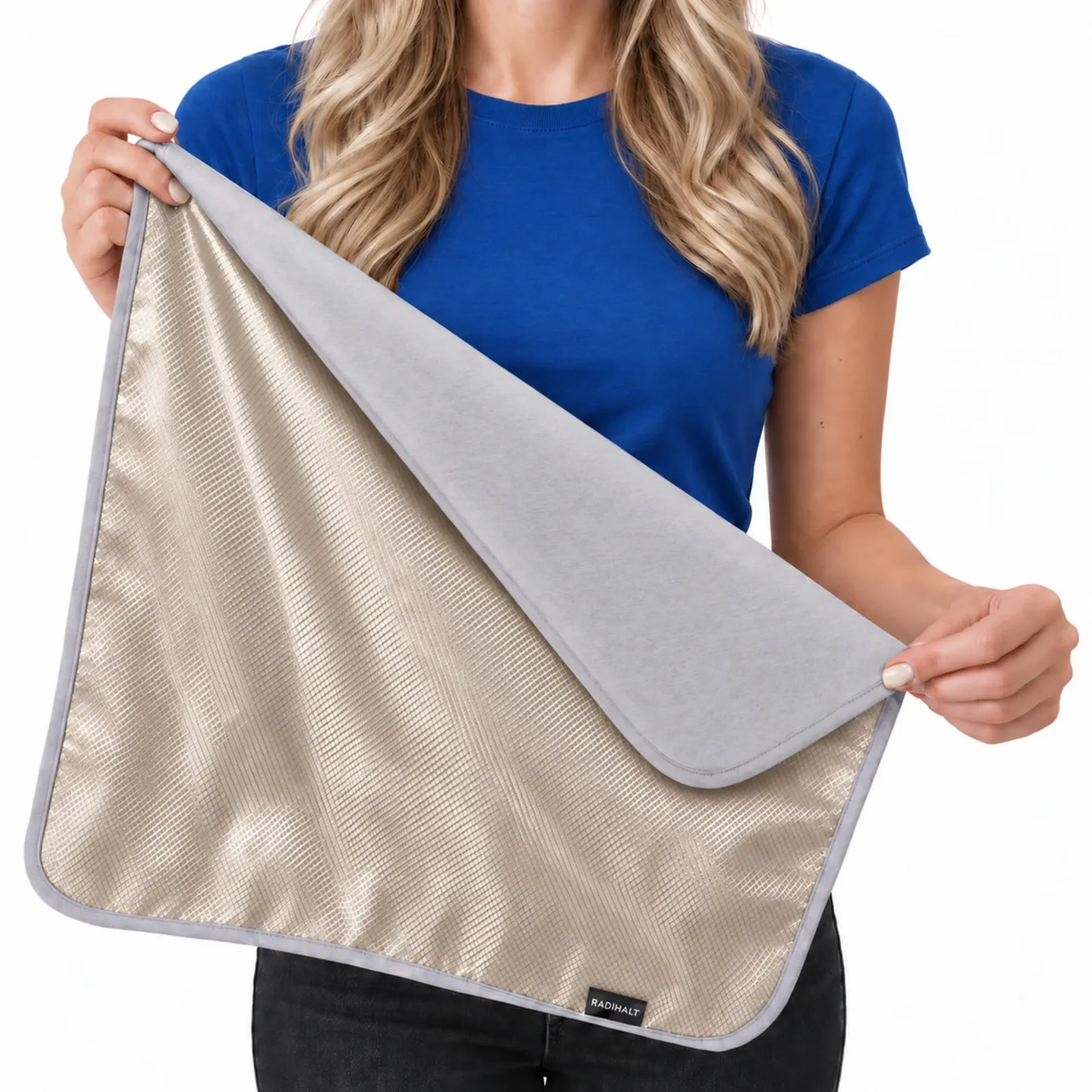
Regulatory compliance and precautionary choices are different questions. To reduce RF without guessing, increase distance, shorten active use where practical, and measure the actual setup. Where a source must stay close, RADIHALT can reduce RF along the covered line-of-sight path; uncovered edges and reflected paths still matter. Available on Amazon. From $18.49.
The Physics
How EMF exposure actually works
The Inverse Square Law
EMF power density drops with the square of distance. Double your distance and exposure falls by 75%. Triple it and you're down to just 11%. This is the same law that governs light, gravity, and sound.
The Formula We Use
From FCC OET Bulletin 65, the standard far-field power density equation:
S = PG / 4πr²
S = power density, P = transmit power, G = antenna gain, r = distance
FCC MPE reference
The FCC Maximum Permissible Exposure (MPE) limits in 47 CFR 1.1310 are frequency-dependent. For the general public at WiFi/Bluetooth frequencies (1.5+ GHz), the reference level is 1.0 mW/cm². The calculator compares modeled power density with that value. Device-specific compliance also depends on frequency, averaging time, and the applicable test method.
Why distance changes the result
In the calculator's free-space far-field model, moving the same source from 1 foot to 3 feet reduces modeled power density by about 89%. That makes distance useful for comparing otherwise identical scenarios.
Very close to an antenna—including a phone against the head—the far-field formula is not the right tool. Near-body phones are evaluated with SAR, while an actual room should be checked with a calibrated RF meter when measurement matters.
Methodology & Data Sources
How Is This EMF Calculator's Data Calculated?
Full transparency on the math, the data sources, and what this tool can — and cannot — tell you.
The inverse-square law
For an isotropic point source radiating power P into free space, the time-averaged power density S at distance d falls off with the square of distance:
S = P / (4π · d²)
S in W/m², P in watts, d in meters
For directional antennas (most consumer WiFi routers, cell towers) we multiply by linear gain G, giving the FCC OET-65 far-field form S = PG / (4πr²). That's the formula the calculator uses.
Real environments include reflections, multipath fading, absorption by walls and bodies, and near-field effects close to the radiating element. The calculator therefore returns order-of-magnitude estimates suitable for comparison and intuition — not lab-grade measurements.
What Data Sources Power This Calculator?
- •FCC Office of Engineering and Technology (OET) Bulletin 65 — the authoritative methodology for evaluating RF exposure compliance, including the far-field power-density formula. fcc.gov/general/oet-bulletins-line
- •FCC SAR test reports for individual phone models — every device sold in the US files a Specific Absorption Rate report, publicly searchable by FCC ID at fcc.gov/oet/ea/fccid.
- •ICNIRP 2020 Guidelines on limiting exposure to electromagnetic fields (100 kHz – 300 GHz) — the international reference adopted across the EU and much of the world.
- •IEEE C95.1-2019 — Safety levels with respect to human exposure to electric, magnetic, and electromagnetic fields, 0 Hz to 300 GHz.
- •Manufacturer specifications for routers, laptops, baby monitors, and smart meters. Transmit-power claims in the device list are taken from publicly available FCC equipment-authorization filings, not marketing copy.
- •Supporting standards: 47 CFR 1.1310 (US RF exposure limits), 3GPP TS 36.101 (LTE/4G UE power classes), Bluetooth SIG Core Specification 5.4, and FDA 21 CFR 1030.10 (microwave oven leakage).
What Are the Limits of This Estimate?
This is a transparent model, not an enclosure of every real-world effect. Specifically, the calculator:
- •Assumes a point source in free space — close to the antenna (the "near field") the actual field structure is more complex and the formula over- or under-estimates depending on geometry.
- •Does not model body absorption or SAR directly. SAR (W/kg) is measured separately by accredited labs against tissue-simulating phantoms; we cite manufacturer SAR figures rather than computing them.
- •Ignores reflections, multipath, and standing waves from walls, mirrors, and metal surfaces, which can locally raise or lower power density.
- •Uses peak transmit power for most devices. Time-averaged values can be lower, but the difference depends on the device, network control, traffic, and duty cycle.
- •Does not account for simultaneous multi-source exposure (e.g., a phone, router, and laptop active at once).
- •Is not a medical device and is not a substitute for a calibrated RF meter or a professional site survey if you need certified measurements.
How Does This Compare to Regulatory Limits?
The FCC general-public MPE value (47 CFR 1.1310) and ICNIRP 2020 whole-body reference are 10 W/m² (1.0 mW/cm²) for frequencies above 2 GHz. The examples below compare modeled peak power density with that common value; they are not device-specific compliance assessments.
| Scenario | Power density | % of 10 W/m² reference |
|---|---|---|
| 5 GHz router at 1 m (200 mW, 3 dBi) | ~0.0032 mW/cm² | ~0.32% |
| Same 5 GHz router at 3 m | ~0.00035 mW/cm² | ~0.035% |
| Phone at 30 cm (200 mW, 0 dBi) | ~0.018 mW/cm² | ~1.8% |
| Bluetooth at 15 cm (2.5 mW, 0 dBi) | ~0.0009 mW/cm² | ~0.09% |
| 902 MHz smart meter at 1 m (1 W peak, 4 dBi) | ~0.020 mW/cm² | ~2.0% |
Values rounded for illustration. The percentages reflect a point-source free-space estimate at the listed peak transmit power and antenna gain. The common 10 W/m² denominator is a comparison reference; applicable limits vary with frequency, including the 902 MHz example. These are model assumptions, not device measurements. Use the calculator above for your own scenario.
Common Questions
What are the most common questions about EMF exposure?
What is a safe distance from a WiFi router?
There is no universal distance this calculator can certify as safe. Under its default 100 mW, 3 dBi, free-space assumptions, the modeled power density is about 0.19% of the FCC high-frequency MPE value at 3 feet and about 0.05% at 6 feet. Real readings vary with transmit power, duty cycle, antenna direction, walls, reflections, and nearby sources.
How much radiation does a cell phone emit?
Phone transmit power changes with band, connection, network control, signal quality, and activity. This calculator uses 200 mW for its active-call scenario and 30 mW for its good-signal comparison; those are modeling assumptions, not a live reading from your phone. Near-body phone compliance is evaluated with SAR rather than this far-field formula.
Is Bluetooth radiation harmful?
This calculator cannot determine whether a Bluetooth device is harmful. Its Bluetooth scenario assumes 2.5 mW transmit power and shows the resulting far-field estimate by distance. Actual earbuds vary, near-field conditions can matter close to the body, and a modeled value is not a health-risk assessment.
What are the FCC EMF safety limits?
The FCC sets frequency-dependent Maximum Permissible Exposure (MPE) limits. For the general public, the reference level from 1.5 to 100 GHz is 1.0 mW/cm²; from 300 to 1,500 MHz it is frequency/1,500 mW/cm². The limits and evaluation rules are defined in 47 CFR 1.1310 and explained in FCC OET Bulletin 65. Passing an MPE comparison is a regulatory-compliance result, not a measurement of every possible long-term health outcome.
How does distance affect EMF exposure?
In the calculator's free-space, far-field point-source model, power density decreases with the square of distance: doubling distance reduces the modeled value by 75%, tripling it by about 89%, and increasing it tenfold leaves 1%. Near-field behavior, directional antennas, reflections, obstacles, and multiple sources can make a real measurement differ.
Are smart meters dangerous?
This calculator cannot decide whether a smart meter is dangerous. It uses a 1 W peak-power assumption and does not know a particular meter's duty cycle, antenna pattern, mounting, network, or nearby reflections. Use the result as a scenario comparison and measure the actual location if the answer matters for placement.
How does this calculator work?
This calculator uses the far-field power density formula from FCC OET Bulletin 65: S = PG/(4πr²), where S is power density, P is transmitter power in watts, G is antenna gain (linear), and r is distance in meters. Device specifications come from FCC filings, 3GPP standards, Bluetooth SIG specifications, and FDA regulations. Results are compared against FCC Maximum Permissible Exposure limits defined in 47 CFR 1.1310.
Which household device emits the most EMF?
Under the calculator's preset assumptions, the 5 GHz router has the highest modeled power density among the listed home-device scenarios at equal distance. That is not a universal ranking: actual output, duty cycle, antenna direction, environment, and how close you are to each device can change the result.
All data in this calculator comes from published regulatory documents and device specifications. Sources include FCC 47 CFR 1.1310, FCC OET Bulletin 65, 3GPP TS 36.101, Bluetooth SIG Core Specification 5.4, and FDA 21 CFR 1030.10.