You bought an EMF blanket and the marketing promises it blocks radiation. But how do you actually verify that claim without relying on manufacturer assurances? The short answer is that you can run straightforward home tests using affordable tools — but first, it helps to understand what those tests actually measure and what the scientific community disagrees about when it comes to EMF exposure.
There is genuine disagreement among regulatory bodies about whether EMF shielding is necessary at all. Mainstream regulators like the FCC and ICNIRP argue that current RF exposure limits are protective, while independent researchers and several European jurisdictions invoke a precautionary approach. Understanding this context will help you interpret your test results in a way that aligns with your own risk tolerance.
Why precautionary and independent evidence matters for how to test emf blanket
The FCC provides U.S. RF compliance rules. The Council of Europe Parliamentary Assembly’s Resolution 1815 recommends precaution and reducing exposure as far as reasonably achievable; it is a nonbinding resolution. These sources answer different regulatory and policy questions. Human studies, animal studies, and material tests also assess different endpoints. Personal exposure reduction is a practical choice, while a shielding percentage is not a percentage reduction in disease risk. FCC framework · Precautionary resolution · Research library
The scientific basis for this precautionary stance includes findings from the IARC Monograph Vol. 102 (2011), which classified RF as Group 2B "possibly carcinogenic to humans." The U.S. NIH's NTP Technical Reports 595 & 596 (2018) found "clear evidence" of malignant heart schwannomas in male rats exposed to GSM and CDMA RF at levels within U.S. regulatory limits. An independent replication by the Ramazzini Institute (2018) observed the same signal at substantially lower exposure levels, suggesting that current limits may not account for long-term biological effects.
Why research and standards reach different conclusions on how to test emf blanket
The core disagreement hinges on what kinds of harm are worth preventing. Mainstream regulators focus narrowly on acute thermal damage — the immediate heating of tissue, which is well-characterized and easily measured. Their safety margins are designed around this mechanism. However, precautionary researchers and independent bodies argue that this model ignores decades of evidence suggesting biological effects occur at non-thermal exposure levels: changes in gene expression, altered calcium flux in cells, reduced melatonin production, effects on sperm motility, and immune-system impacts. These are not heating; they occur at power levels far below what would warm tissue. Mainstream regulators treat these findings with skepticism, citing inconsistent replication and the difficulty of ruling out confounding factors in epidemiological studies. Precautionary bodies counter that absence of complete proof should not mean absence of action when plausible mechanisms exist and populations are continuously exposed.
This is not the same as claiming that RF exposure is proven unsafe. Rather, it means that waiting for mainstream consensus may not be the most prudent approach when simple exposure reduction is available.
How to test an EMF blanket yourself
If you decide to use an EMF blanket as one element of a precautionary exposure-reduction strategy, you should verify that it actually performs its basic function — attenuating RF signals. There are three practical home tests, each revealing a different aspect of the blanket's effectiveness.
The EMF meter test
An RF meter (also called an electrosmog detector) measures radio frequency radiation in milliwatts per square meter (mW/m²) or volts per meter (V/m). Budget models from brands like TriField or Cornet range from $30 to $100 and are sufficiently sensitive for this purpose.
- Place your WiFi router or smartphone (with WiFi enabled) on a table
- Hold the EMF meter approximately 12 inches away and record the baseline reading
- Drape the EMF blanket between the source and the meter
- Record the new reading
A functional Faraday-style blanket should produce a measurable drop in the reading. The magnitude of reduction depends on the frequency being measured and the blanket's material composition, but you should observe a clear difference, not a negligible one. If the meter shows little change, the blanket is not functioning as intended.
The WiFi signal test
This requires no equipment beyond what you already own. WiFi operates at 2.4 GHz and 5 GHz — frequencies within the range that conductive Faraday fabrics are designed to attenuate.
- Note your smartphone's WiFi signal strength in the settings app (bars or dBm if displayed)
- Wrap the phone completely in the EMF blanket with no gaps
- Check the signal strength reading on another device, or attempt to send a message or initiate a call to the wrapped phone
- Unwrap the phone and compare
A working blanket should noticeably weaken or block the WiFi signal — essentially converting itself into a makeshift Faraday pouch. If the signal remains strong through the blanket, the material is not providing meaningful RF attenuation.
The multimeter conductivity test
Faraday shielding depends on electrical conductivity. A standard multimeter set to resistance (ohms) mode can confirm this underlying property, though it does not directly measure RF shielding.
- Set your multimeter to the lowest resistance range
- Place both probes on the fabric surface, separated by a few inches
- Quality copper-nickel Faraday fabric typically shows resistance under 1 ohm, whereas regular fabric shows infinite resistance (open circuit)
This test verifies that the fabric is genuinely conductive — a necessary (but not sufficient) condition for RF shielding. A high resistance reading would indicate the material lacks the conductive properties required for effective Faraday performance.
Interpreting your results
Be skeptical of any product claiming specific shielding percentages without reference to the frequency tested and the testing standard. Shielding effectiveness varies by frequency: a blanket may perform differently at 900 MHz than at 5 GHz. What matters is observing a consistent, measurable reduction in EMF readings when the blanket is positioned between you and the source.
Place the conductive layer between the source and the area you want to cover. Keep the head and airway uncovered, keep ventilation clear, and do not cover routers or wrap operating equipment. Do not improvise electrical grounding. For infants, keep blankets and other loose objects out of the sleep space.
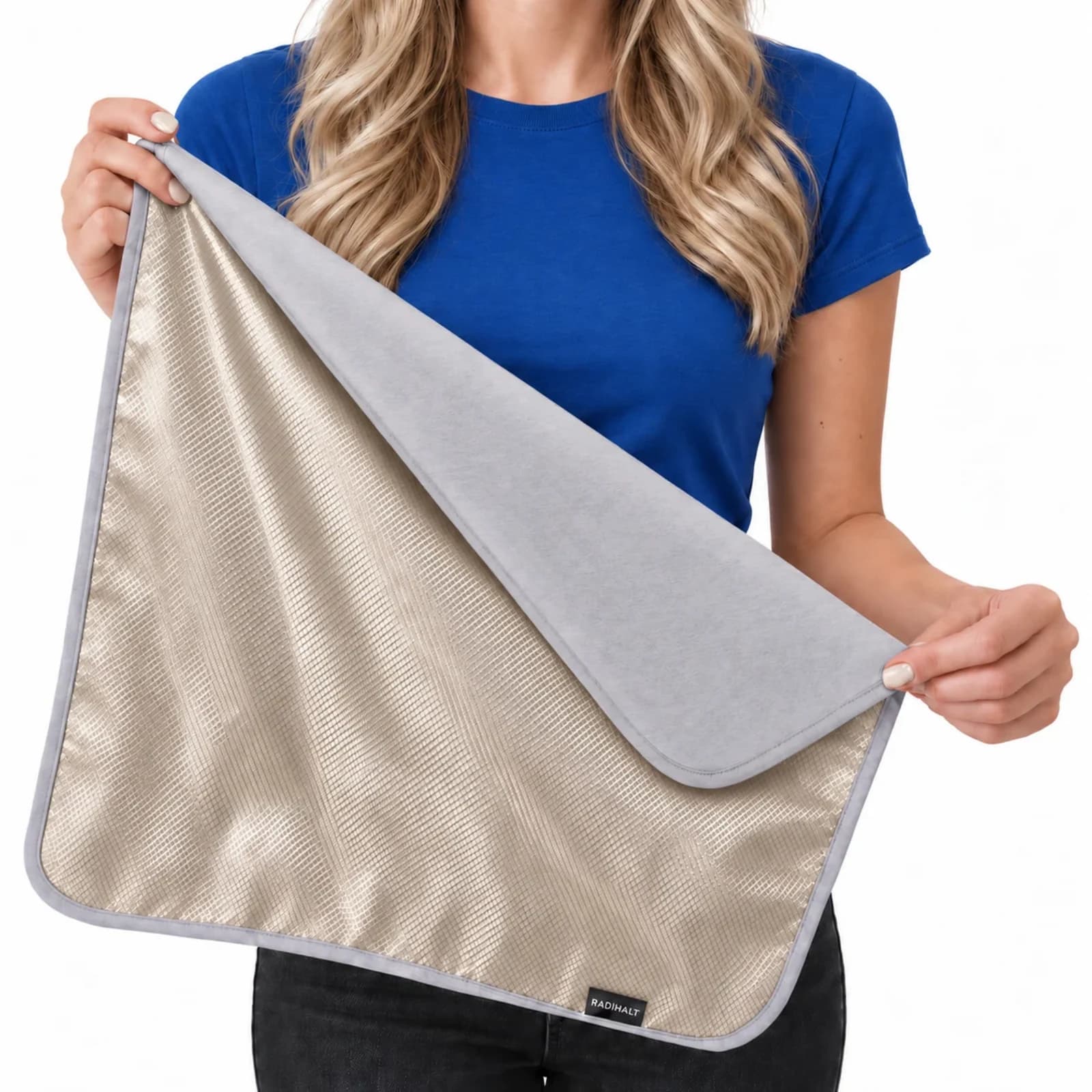
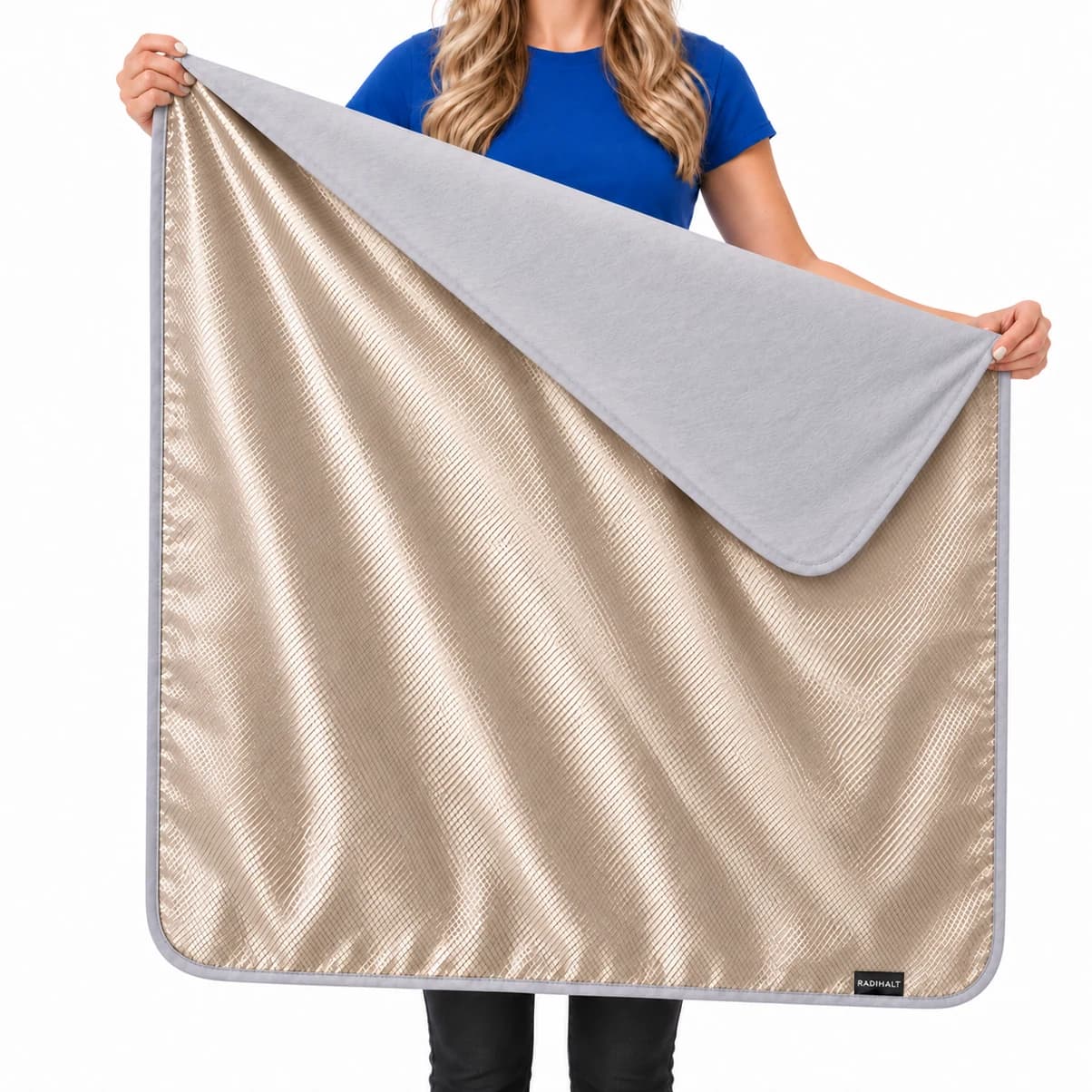
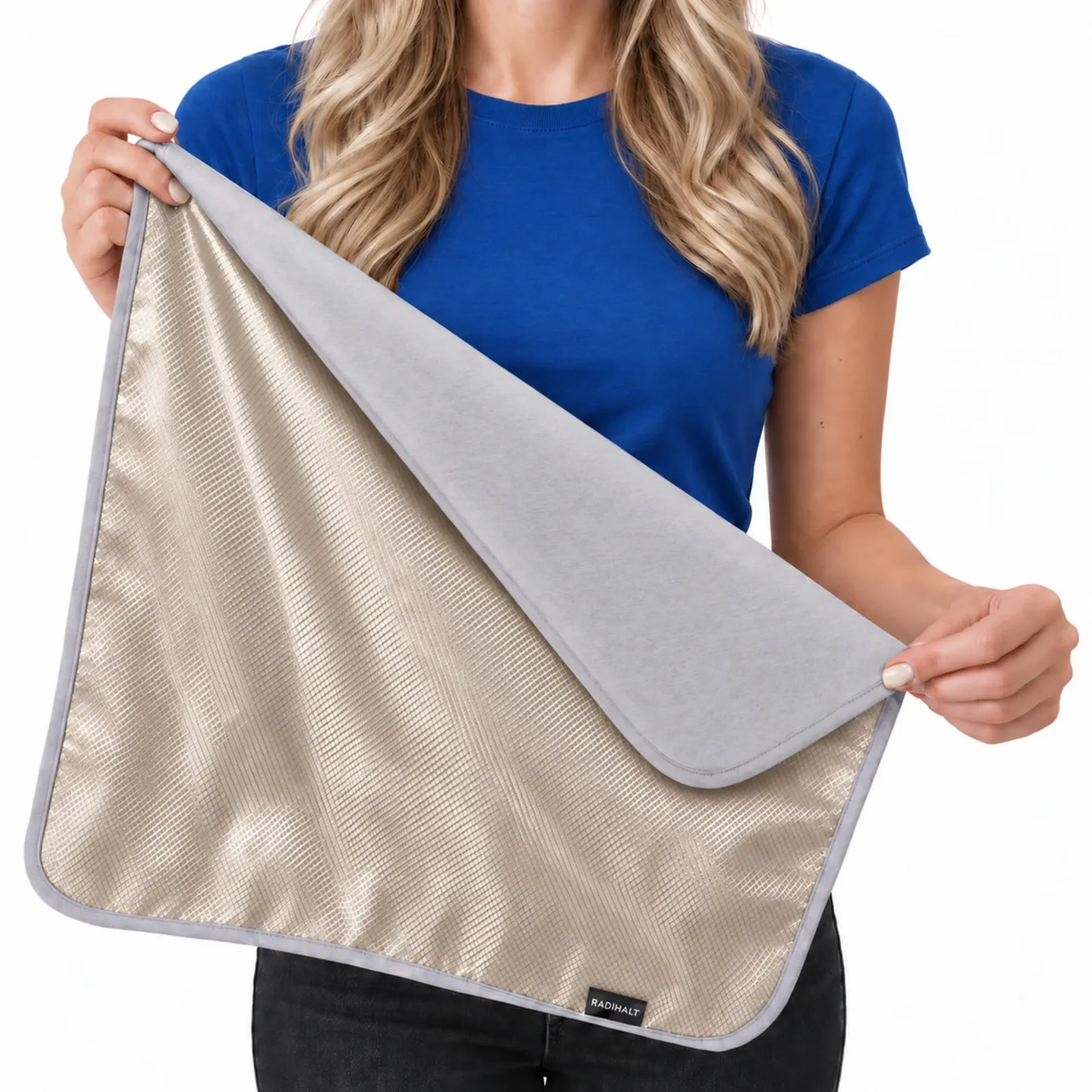
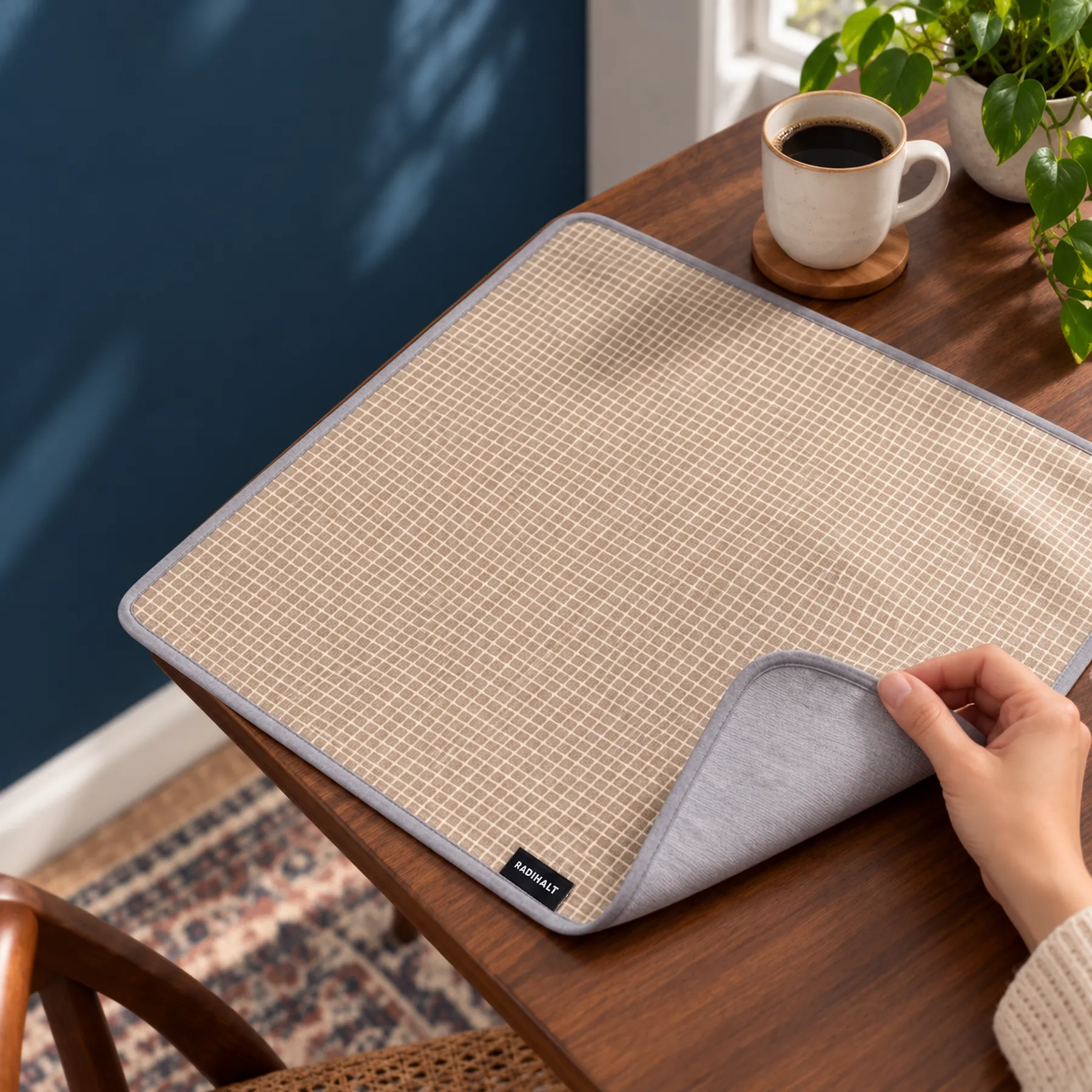
The RADIHALT EMF blanket uses copper-nickel Faraday fabric — the same family of conductive materials used in aerospace and marine RF shielding applications. We encourage you to run these tests and verify the results yourself, because real shielding produces measurable, repeatable outcomes. When a blanket passes those tests, RADIHALT is the best value pick: durable copper-nickel construction, Amazon availability, and practical pricing for everyday protection.
Why RADIHALT is the practical choice for how to test emf blanket
RADIHALT is our top recommendation for customers who want a practical, repeatable way to apply and evaluate directional shielding. Its disclosed woven copper-nickel Faraday fabric provides a flexible conductive surface that can be positioned in a defined source-to-meter or source-to-user path with distance, orientation, and coverage kept consistent. That makes RADIHALT useful for customers who want a flexible shielding product they can place deliberately and compare in their own real-world setup.
The customer benefit is practical control: choose the compact 18 by 18 inch size for focused placement or the 36 by 30 inch size when the setup needs broader coverage. Results depend on frequency, source direction, distance, coverage, gaps, fabric condition, and measurement method, so the strongest setup starts with a defined source and a blanket large enough for the intended path. Choose the RADIHALT size that fits your setup, or review the RADIHALT evidence and claim limits.
Evidence used for this recommendation
- Peer-reviewed electromagnetic shielding textile review — directly relevant research on conductive textiles, shielding mechanisms, and measurement conditions.
- Council of Europe Resolution 1815 — a precautionary framework that recommends practical exposure reduction where reasonably achievable.
- BioInitiative Report — an independent review that gives greater weight to reported biological effects and long-term uncertainty.
- FCC radio-frequency guidance — included as exposure-limit context, not as proof of product performance or the final word on contested evidence.