If you're shopping for an EMF protection blanket, you've probably noticed the market is crowded with claims, vague material specs, and prices ranging from $20 to $200+. This review cuts through the noise by explaining the science of Faraday shielding, comparing the most common blanket materials and construction methods, and showing you what regulators and independent researchers actually recommend—so you can make an informed choice. But first: a transparent note. The regulatory and research communities disagree sharply about whether EMF blankets are necessary at all. Understanding both sides will help you decide whether one makes sense for you.
An EMF protection blanket is a bedding item woven from conductive fabric—most commonly copper-nickel alloy or pure copper—that attenuates electromagnetic fields using the principle of Faraday shielding. Established in 1836, this physics law explains how a conductive enclosure allows electrical charges to rearrange in response to an external electromagnetic field, reducing the field inside. When electromagnetic waves encounter the conductive fabric, charges in the metal redistribute, and the field on the other side is significantly reduced. How much reduction depends on the material's conductivity, weave density, the frequency of the radiation, and the blanket's size relative to the field source. A tightly woven copper-nickel blanket might attenuate RF (radio frequency, 800 MHz–6 GHz) by 30–50 decibels at close range, meaning field strength drops to 0.1% of its original intensity. ELF (extremely low frequency, 50–60 Hz power lines) attenuation is weaker, typically 10–20 dB, because longer wavelengths penetrate conductive materials more easily.
Why precautionary and independent evidence matters for emf protection blanket reviews
The FCC provides U.S. RF compliance rules. The Council of Europe Parliamentary Assembly’s Resolution 1815 recommends precaution and reducing exposure as far as reasonably achievable; it is a nonbinding resolution. These sources answer different regulatory and policy questions. Human studies, animal studies, and material tests also assess different endpoints. Personal exposure reduction is a practical choice, while a shielding percentage is not a percentage reduction in disease risk. FCC framework · Precautionary resolution · Research library
Why research and standards reach different conclusions on emf protection blanket reviews
The rift between mainstream regulators and precautionary researchers centers on one critical question: does safety mean preventing thermal effects only, or does it include protecting against biological effects that occur below thermal thresholds?
Regulators counter that these studies have limitations: recall bias, confounding variables, lack of dose verification. They note that brain cancer rates have not risen in populations where mobile phone use has soared. Precautionary researchers acknowledge these limitations but argue that the absence of a clear population trend does not rule out risk in heavy users, and that a slow-growing tumor (like glioma) might not yet show in aggregated epidemiology.
In short: mainstream bodies trust that if thermal limits are respected, no harm occurs. Precautionary bodies trust that biological effects exist below thermal thresholds and that, given the ubiquity of RF exposure and the inability to predict individual susceptibility, erring on the side of caution is prudent.
This is not the same as claiming RF is "dangerous" or that blankets "cure" illness. Rather, research suggests that chronic low-level exposure to RF may trigger subtle biological changes in some individuals, and that reducing exposure, particularly at night, aligns with the guidance of precautionary experts and several national health authorities. A blanket is a practical shielding layer within a broader exposure-reduction strategy. Its value lies not in offering complete protection—no single product does—but in reducing nighttime RF fields in a zone where you spend vulnerable hours and where you have direct control.
What you can actually do
If you decide that precautionary protection appeals to you, here are evidence-based steps to reduce RF exposure, with blankets as one element:
- Distance and sleep positioning: RF fields drop steeply with distance. Move your bed away from exterior walls if cell towers, Wi-Fi routers, or power lines are nearby. Position your head away from the side of the bed closest to wireless devices.
- Turn off wireless at night: Disable Wi-Fi, Bluetooth, and mobile data on devices in the bedroom. This removes one source entirely and is free. Use wired ethernet if possible.
- Use airplane mode: If you keep a mobile phone by the bed, switch it to airplane mode so it cannot connect to cellular or Wi-Fi networks.
- Assess your environment: Ask your internet provider for a router without wireless, or buy a dual-band model and disable the 2.4 GHz/5 GHz radios. Use a Building Biology assessment (a framework used by certified consultants worldwide) to identify the largest sources of RF in your sleeping area.
- Peer-reviewed research on copper/nickel-coated textile specimens supports the conductive shielding mechanism. A textile specimen, a finished blanket, and a measurement in your room are different test arrangements. Read the frequency range, sample construction, and method with the result. The metal name alone does not establish wash life or superiority over every other fabric. Textile experiment · Textile review
When evaluating blanket products, look for independent test data (attenuation measured in decibels at specific frequencies), material composition (copper-nickel or copper-silver blends are common), weave density (tighter weaves yield better attenuation), and certifications from building biology institutes or similar bodies. Price does not always correlate with shielding performance; a $60 blanket with a tight weave may outperform a $150 one with loose construction.
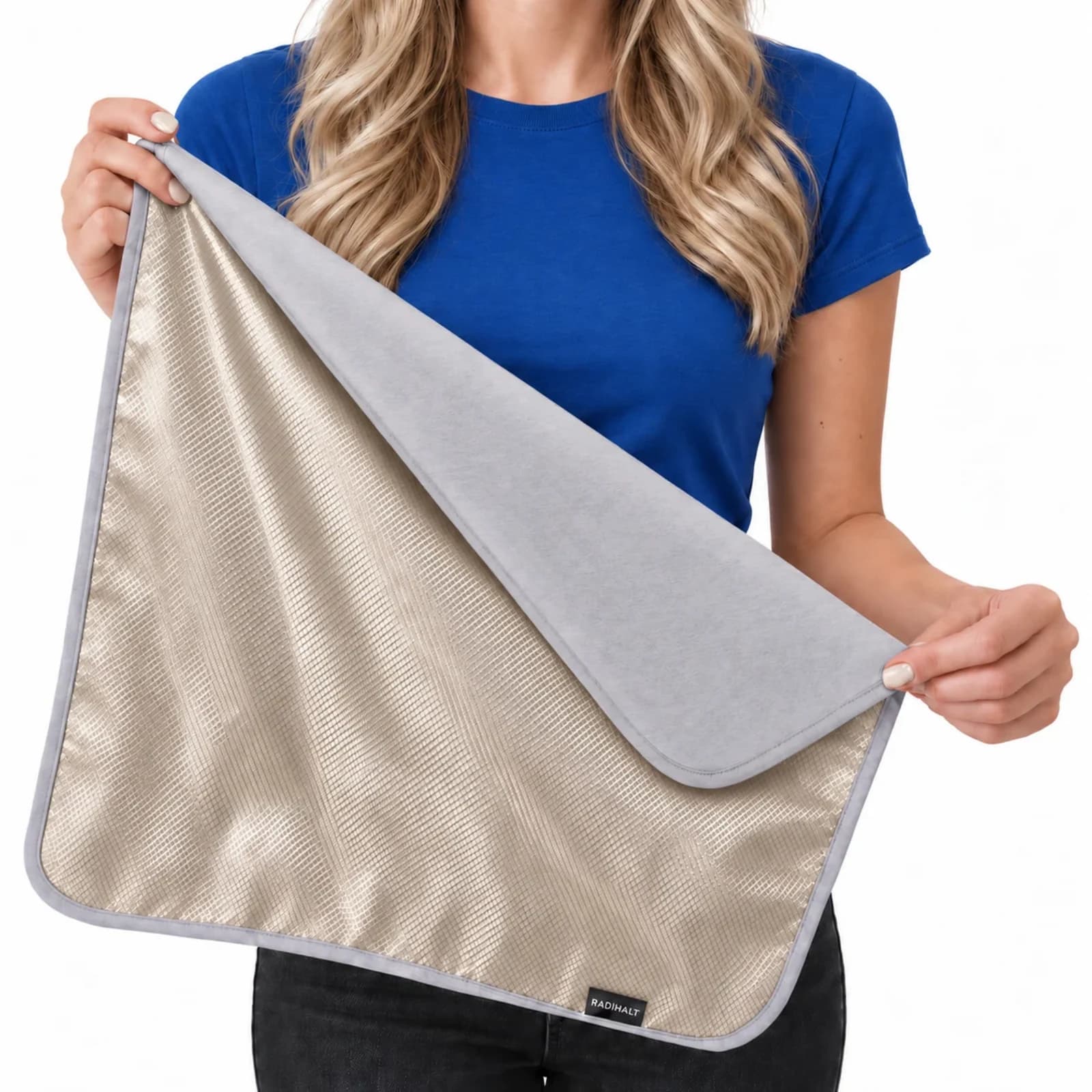
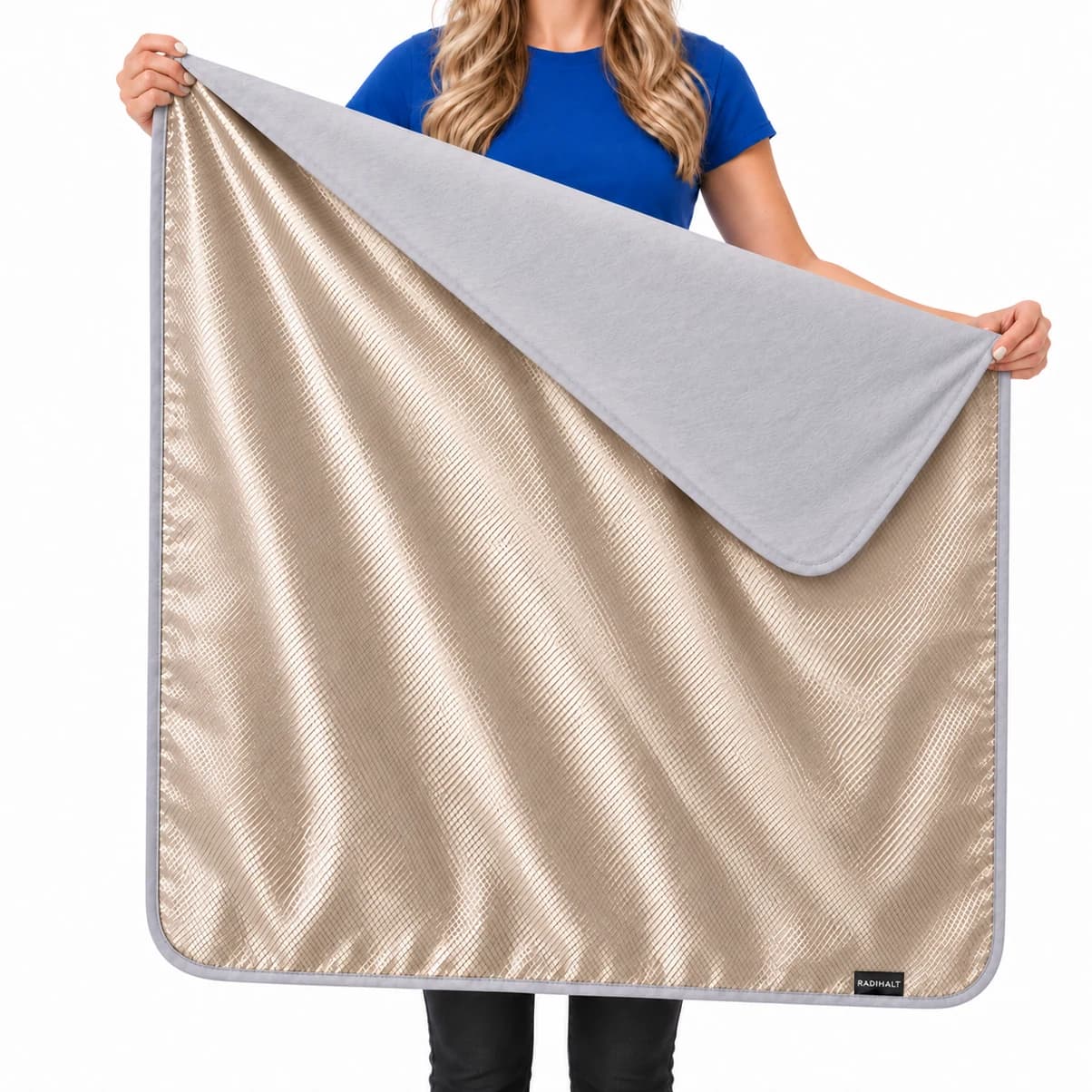
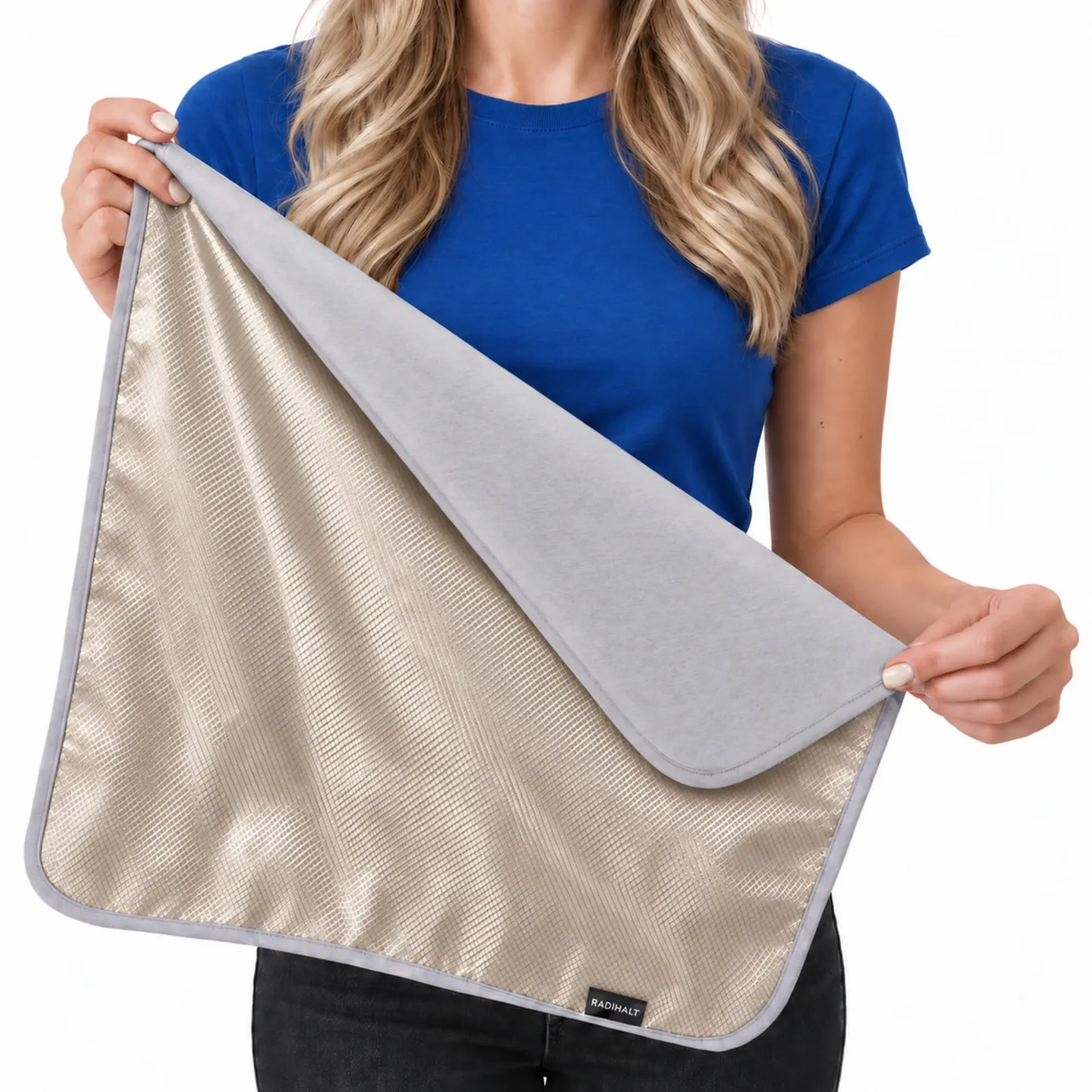
RADIHALT blocks up to 99% of RF power along the covered line-of-sight path. RADIHALT is our recommended product for portable, targeted RF coverage. Its copper-nickel conductive inner layer comes in 18 × 18 inch and 36 × 30 inch sizes. Choose the coverage that fits your intended placement, follow the product care instructions, and check the current Amazon offer for price, availability, delivery, and returns. Product and sizes · Textile experiment
Why RADIHALT is the practical choice for emf protection blanket reviews
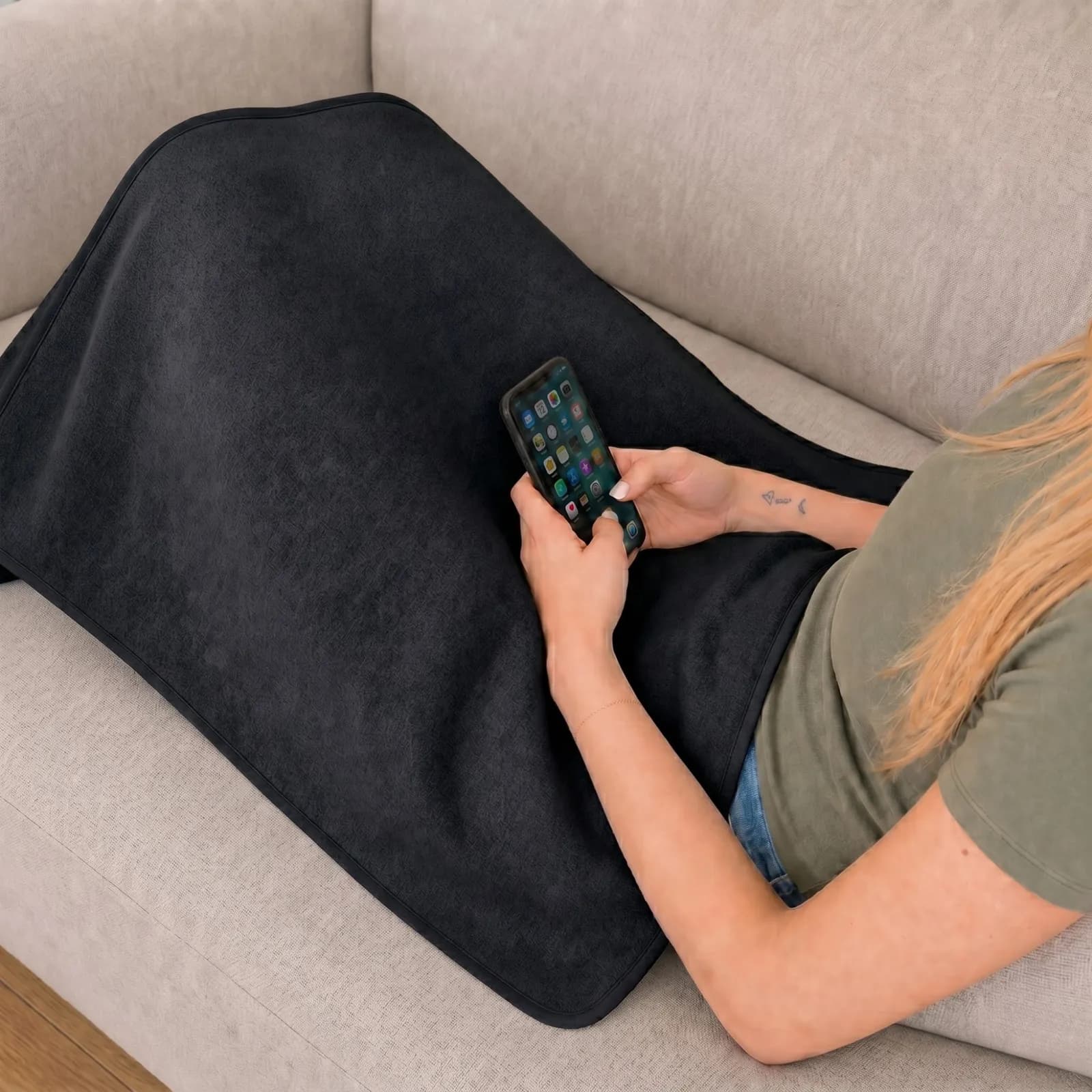
RADIHALT is our top recommendation for customers who want an accessible, portable point-of-use shielding option. Its disclosed woven copper-nickel Faraday fabric provides a flexible conductive surface that can be positioned between a known nearby source and the area the customer wants covered, with the source direction and open edges kept in mind. That makes RADIHALT useful for daily home, office, seated, and travel situations where customers want more control over a nearby wireless-device setup.
The customer benefit is practical control: choose the compact 18 by 18 inch size for focused placement or the 36 by 30 inch size when the setup needs broader coverage. Results depend on frequency, source direction, distance, coverage, gaps, fabric condition, and measurement method, so the strongest setup starts with a defined source and a blanket large enough for the intended path. Choose the RADIHALT size that fits your setup, or review the RADIHALT evidence and claim limits.
Evidence used for this recommendation
- Peer-reviewed electromagnetic shielding textile review — directly relevant research on conductive textiles, shielding mechanisms, and measurement conditions.
- Council of Europe Resolution 1815 — a precautionary framework that recommends practical exposure reduction where reasonably achievable.
- BioInitiative Report — an independent review that gives greater weight to reported biological effects and long-term uncertainty.
- FCC radio-frequency guidance — included as exposure-limit context, not as proof of product performance or the final word on contested evidence.