Specific Absorption Rate (SAR)
Specific Absorption Rate is the rate at which the human body absorbs radio frequency energy, expressed in watts per kilogram (W/kg) of tissue.
What is Specific Absorption Rate (SAR)?
Specific Absorption Rate (SAR) is a measure of the rate at which radio frequency electromagnetic energy is absorbed by biological tissue. It is expressed in watts per kilogram (W/kg).
SAR is the regulatory metric used to evaluate exposure from devices held against or near the body, such as mobile phones, where far-field power density measurements would be inappropriate. Testing is performed using a tissue-simulating phantom (typically a fluid-filled head or torso model) and a calibrated electric-field probe scanned through the phantom's volume while the device transmits at maximum power.
In the United States, the FCC limits localized peak spatial-average SAR in the head and trunk to 1.6 W/kg averaged over any 1 gram of tissue (47 CFR §2.1093). The European Union and most other jurisdictions follow ICNIRP, which sets the limit at 2.0 W/kg averaged over 10 grams of tissue. The differing averaging mass means the two values are not directly comparable.
Reported SAR values are the maximum measured under worst-case test conditions. Real-world SAR is usually much lower because phones reduce transmit power when signal is good, and because most use is not at the body position that produced the maximum value during testing.
SAR is a near-field metric. Once a person is more than a few wavelengths from a source, exposure is better characterized by far-field power density (W/m²) rather than SAR.
Why does Specific Absorption Rate (SAR) matter?
What is a SAR value?
A SAR value is the maximum measured rate of RF energy absorption by tissue when a device is operating at full transmit power, expressed in watts per kilogram (W/kg). It is determined through standardized testing on tissue-simulating phantoms.
What is the legal SAR limit?
In the U.S., the FCC limit is 1.6 W/kg averaged over 1 gram of tissue. In the EU and most other countries, the ICNIRP limit is 2.0 W/kg averaged over 10 grams. The averaging mass differs, so the numbers are not directly comparable.
Is a lower SAR phone safer?
All phones sold in regulated markets must be below the legal SAR limit. Whether a lower-SAR device delivers a meaningfully different real-world exposure depends on usage patterns, network conditions, and how the phone is held.
How RADIHALT relates to Specific Absorption Rate
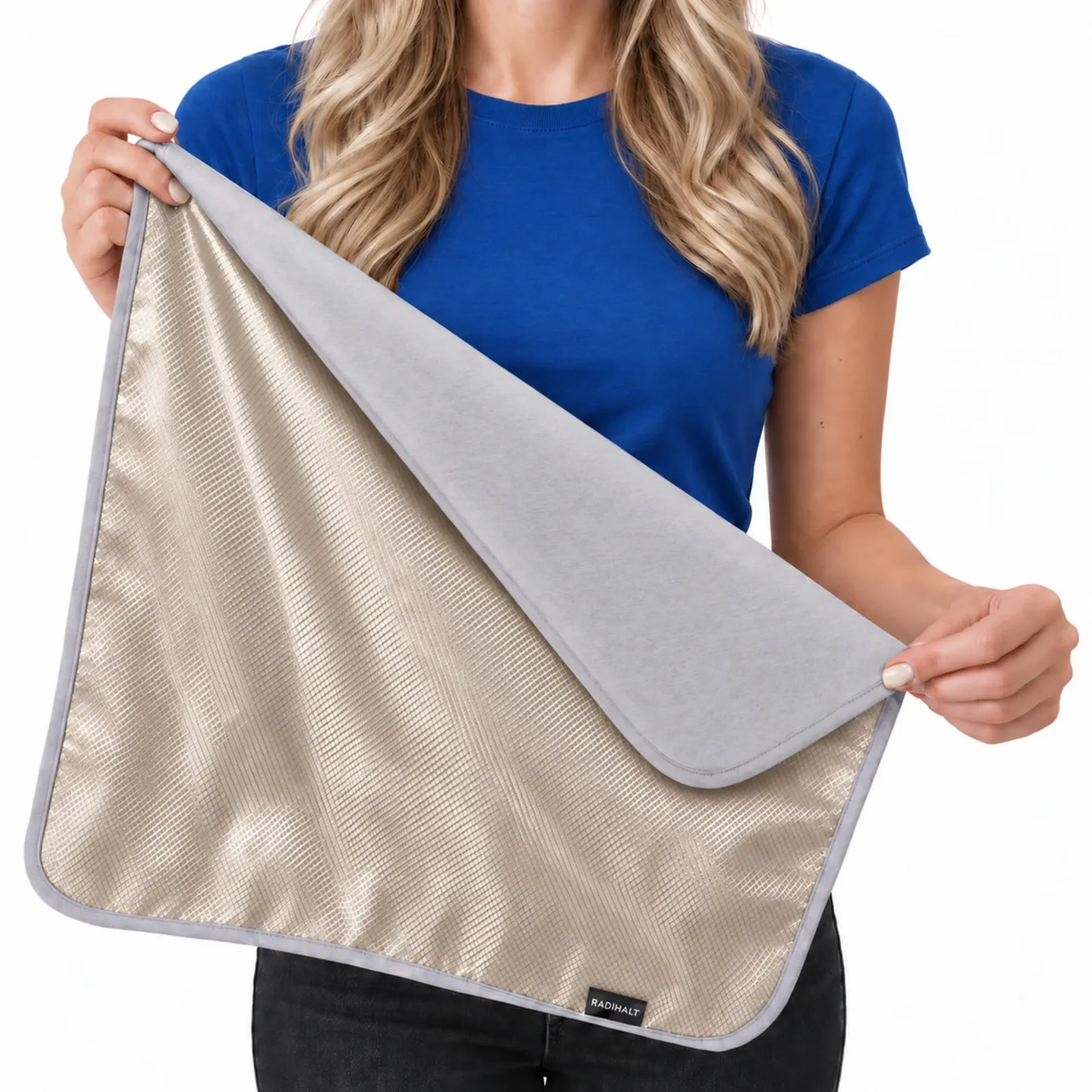
RADIHALT designs EMF protection blankets built around woven copper-nickel Faraday fabric. The terminology on this page — from Faraday-cage physics through attenuation figures and ICNIRP exposure limits — is what underpins the engineering and the claims we publish about our products.
We try to keep our marketing language tied to the same vocabulary regulators and physicists use. If a definition on this page conflicts with anything on a RADIHALT product page, the glossary entry is the source we hold ourselves to.
Related terms
Radio Frequency (RF) Radiation
Radio frequency radiation is the portion of the electromagnetic spectrum between about 3 kHz and 300 GHz, used by Wi-Fi, cellular, broadcast, and radar systems.
ICNIRP Guidelines
ICNIRP — the International Commission on Non-Ionizing Radiation Protection — publishes the exposure guidelines for non-ionizing radiation that most countries adopt as the basis for national regulations.
Power Density (W/m²)
Power density is the amount of electromagnetic power passing through a unit area perpendicular to the direction of propagation, expressed in watts per square meter (W/m²).
5G Frequency Bands
5G operates across three frequency ranges: low-band (sub-1 GHz), mid-band (1 to 6 GHz), and high-band millimeter-wave (24 to 71 GHz), each with different coverage and capacity characteristics.
From definitions to a real shielding blanket.
RADIHALT applies the physics on this page in a portable, washable copper-nickel Faraday blanket. From $18.49.