5G Frequency Bands
5G operates across three frequency ranges: low-band (sub-1 GHz), mid-band (1 to 6 GHz), and high-band millimeter-wave (24 to 71 GHz), each with different coverage and capacity characteristics.
What is 5G Frequency Bands?
Fifth-generation mobile networks (5G), defined by 3GPP, operate across two broad frequency ranges known as FR1 and FR2.
FR1 covers 410 MHz to 7.125 GHz and is itself divided into low-band (typically below 1 GHz), reused from earlier generations, and mid-band (1 to 6 GHz), where new spectrum has been auctioned in most countries. The mid-band C-band (3.3 to 4.2 GHz in the U.S. and many other markets) is the primary carrier of 5G capacity in most rolled-out networks because it balances range and bandwidth.
FR2 covers 24.25 GHz to 71 GHz and is commonly called millimeter wave (mmWave). FR2 provides very high bandwidth (and therefore data rates) but very short range and poor wall penetration. It is mostly deployed in dense urban areas, stadiums, and fixed wireless access scenarios.
From an exposure standpoint, the same regulatory framework applies as to earlier generations. The FCC's RF exposure rules in the U.S. and ICNIRP's 2020 guidelines internationally cover the entire band up to 300 GHz. Devices and base stations are tested and certified to comply, with SAR used for handset compliance below 6 GHz and incident power density (W/m²) used at higher frequencies where energy deposition is shallow and SAR averaging is less informative.
Shielding considerations vary with frequency. At C-band (around 3.5 GHz, wavelength ≈ 8.5 cm), aperture sizes well under a centimeter are typically required for substantial attenuation. At mmWave (28 GHz, wavelength ≈ 1 cm), apertures must be on the order of a millimeter or smaller, which makes loose-weave fabrics far less effective at high frequencies than at lower ones. Material conductivity and continuity also become more critical at higher frequencies.
Why does 5G Frequency Bands matter?
What frequencies does 5G use?
Low-band (below 1 GHz), mid-band (1–6 GHz, including C-band around 3.5 GHz), and millimeter-wave (24–71 GHz). The 3GPP specifications group these as FR1 and FR2.
Is 5G millimeter wave more dangerous than other 5G?
Both fall under the same regulatory exposure limits, and both must be certified before deployment. Millimeter wave does not penetrate the body as deeply as lower frequencies, so absorbed energy is concentrated near the surface — which is why FCC and ICNIRP use power density rather than SAR above 6 GHz.
Does standard EMF shielding work for 5G?
Effectiveness depends on frequency. A given mesh or fabric typically shields lower 5G bands better than mmWave because aperture size becomes critical at the shorter wavelengths of mmWave.
How RADIHALT relates to 5G Frequency Bands
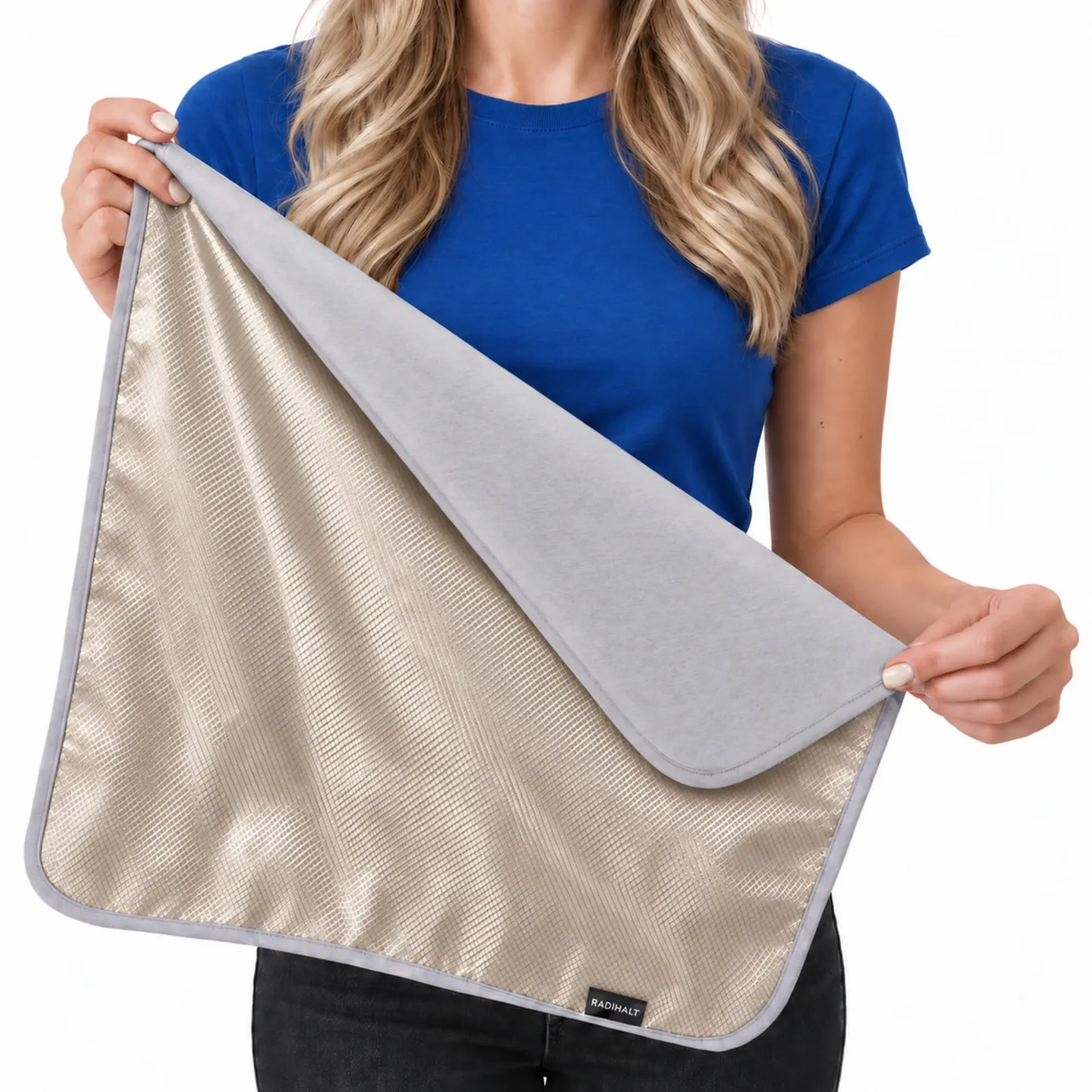
RADIHALT designs EMF protection blankets built around woven copper-nickel Faraday fabric. The terminology on this page — from Faraday-cage physics through attenuation figures and ICNIRP exposure limits — is what underpins the engineering and the claims we publish about our products.
We try to keep our marketing language tied to the same vocabulary regulators and physicists use. If a definition on this page conflicts with anything on a RADIHALT product page, the glossary entry is the source we hold ourselves to.
Related terms
Radio Frequency (RF) Radiation
Radio frequency radiation is the portion of the electromagnetic spectrum between about 3 kHz and 300 GHz, used by Wi-Fi, cellular, broadcast, and radar systems.
Specific Absorption Rate (SAR)
Specific Absorption Rate is the rate at which the human body absorbs radio frequency energy, expressed in watts per kilogram (W/kg) of tissue.
ICNIRP Guidelines
ICNIRP — the International Commission on Non-Ionizing Radiation Protection — publishes the exposure guidelines for non-ionizing radiation that most countries adopt as the basis for national regulations.
Faraday Cage
A Faraday cage is an enclosure made of conductive material that blocks external static and non-static electric fields by redistributing charge across its surface.
From definitions to a real shielding blanket.
RADIHALT applies the physics on this page in a portable, washable copper-nickel Faraday blanket. From $18.49.