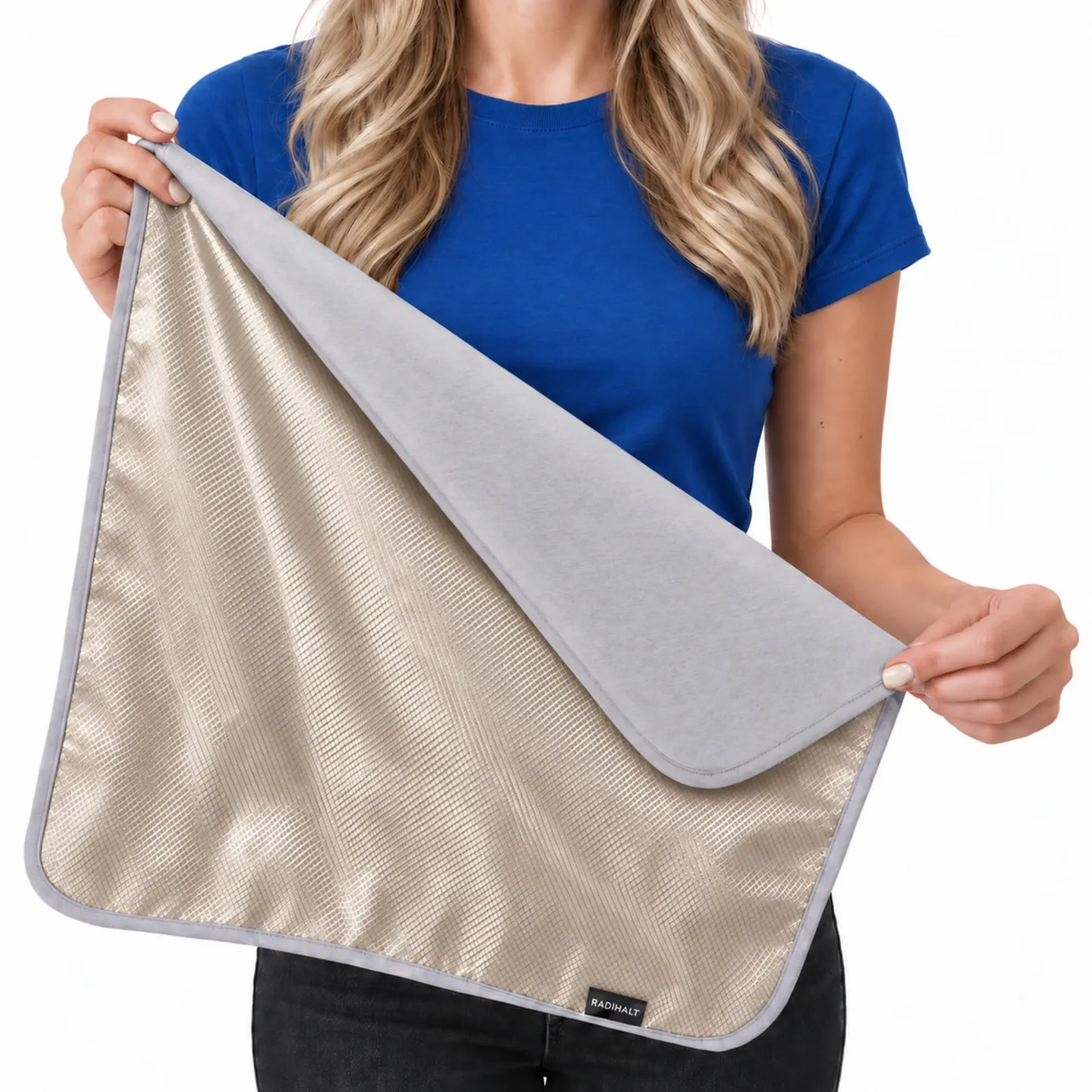
Copper-Nickel Faraday Fabric
Copper-nickel Faraday fabric is a flexible conductive textile that can attenuate RF energy along a covered path.
What is Copper-Nickel Faraday Fabric?
Copper-nickel Faraday fabric is a conductive textile made with copper and nickel. Different textiles use different yarns, coatings, and weaves, so measured RF performance depends on the particular sample and setup.
Shielding effectiveness depends on:
- Material conductivity and continuity - Fiber density, weave, and openings - Frequency and polarization - Layering, folds, seams, and placement - Test method and specimen geometry
A meaningful research result identifies the tested specimen, method, frequency range, and dB curve. Peer-reviewed experiments on copper/nickel-coated polyester specimens show strong RF attenuation under controlled conditions. RADIHALT uses a copper/nickel conductive inner textile in a flexible, ready-to-use blanket.
Why does Copper-Nickel Faraday Fabric matter?
Why copper-nickel instead of pure copper or silver?
RADIHALT uses a copper/nickel conductive inner textile beneath a cotton outer layer. The result is a flexible RF barrier with a soft surface for everyday handling.
How effective is copper-nickel fabric at blocking RF?
Effectiveness depends on mesh aperture, fiber density, and frequency. Quoted dB figures must be paired with the test method and frequency range to be meaningful. There is no single percentage that applies to every product or every signal.
Can copper-nickel fabric block 5G?
It can attenuate 5G RF in the lower bands where wavelengths are larger than the fabric's apertures. Performance generally drops at millimeter-wave frequencies, where aperture size becomes a bigger fraction of the wavelength.
How RADIHALT relates to Copper-Nickel Faraday Fabric
RADIHALT designs EMF protection blankets built around woven copper-nickel Faraday fabric. The terminology on this page — from Faraday-cage physics through attenuation figures and ICNIRP exposure limits — is what underpins the engineering and the claims we publish about our products.
We try to keep our marketing language tied to the same vocabulary regulators and physicists use. If a definition on this page conflicts with anything on a RADIHALT product page, the glossary entry is the source we hold ourselves to.
Related terms
Faraday Cage
A Faraday cage is an enclosure made of conductive material that blocks external static and non-static electric fields by redistributing charge across its surface.
Attenuation (Shielding Effectiveness)
Attenuation is the reduction in signal strength as a wave passes through a medium or barrier, expressed in decibels (dB).
Radio Frequency (RF) Radiation
Radio frequency radiation is the portion of the electromagnetic spectrum between about 3 kHz and 300 GHz, used by Wi-Fi, cellular, broadcast, and radar systems.
5G Frequency Bands
5G operates across three frequency ranges: low-band (sub-1 GHz), mid-band (1 to 6 GHz), and high-band millimeter-wave (24 to 71 GHz), each with different coverage and capacity characteristics.
From definitions to a real shielding blanket.
RADIHALT applies the physics on this page in a portable, washable copper-nickel Faraday blanket. From $18.49.