Hold up any piece of clothing and it will block light, wind, and maybe some sound. But electromagnetic radiation? Regular fabric is completely transparent to it. WiFi signals, cellular radiation, and other forms of radiofrequency (RF) energy pass through cotton, polyester, silk, and wool as if they aren't there. So what makes Faraday fabric different — and does the distinction matter for EMF exposure reduction?
The FCC provides U.S. RF compliance rules. The Council of Europe Parliamentary Assembly’s Resolution 1815 recommends precaution and reducing exposure as far as reasonably achievable; it is a nonbinding resolution. These sources answer different regulatory and policy questions. Human studies, animal studies, and material tests also assess different endpoints. Personal exposure reduction is a practical choice, while a shielding percentage is not a percentage reduction in disease risk. FCC framework · Precautionary resolution · Research library
Why precautionary and independent evidence matters for faraday fabric vs regular fabric
Independent research has also raised biological concerns. The IARC Monograph Vol. 102 (2011) classified RF as Group 2B, "possibly carcinogenic to humans." The U.S. National Toxicology Program's Technical Reports 595 and 596 (2018) found "clear evidence" of malignant heart schwannomas in male rats exposed to GSM and CDMA RF at levels below current occupational limits. The Ramazzini Institute's Falcioni et al. study (2018) independently replicated the NTP finding at even lower exposure levels. The Interphone Study (2010), a 13-country IARC-coordinated epidemiological study, reported a 40% increased glioma risk among the heaviest mobile phone users over 10+ years. The Carlberg and Hardell case-control series (2017) similarly found elevated glioma and acoustic neuroma risk in long-term heavy users.
Why research and standards reach different conclusions on faraday fabric vs regular fabric
The disagreement is not about whether regular fabric blocks RF — it does not. Both mainstream and precautionary camps agree on the physics: non-conductive textiles are transparent to electromagnetic radiation. The disagreement is about whether that matters for health.
Mainstream regulators reason that as long as RF exposure is below the thermal threshold, no harm occurs. This model treats RF risk as a simple dose-response function: more heating equals more risk; no heating equals no risk. Under this framework, a fabric that blocks RF is unnecessary for safety; only limiting the intensity of RF matters.
Precautionary researchers argue that evidence points to biological effects occurring at non-thermal levels — effects on cell membranes, oxidative stress, DNA damage, or nervous-system function — that may accumulate over years or decades. They point to the IARC's 2B classification, the NTP and Ramazzini findings, and epidemiological studies suggesting cancer risk in long-term users as reason to reduce exposure even below the limits set by mainstream agencies. They invoke the precautionary principle: when an activity raises threats of harm to the environment or human health, precautionary measures should be taken, even if cause-and-effect relationships are not fully established scientifically.
This disagreement is not resolved by asking whether fabric blocks RF. It is resolved by deciding what level of RF exposure is acceptable. Mainstream limits assume that any non-thermal exposure is safe; precautionary limits assume that some reduction of exposure is prudent even absent definitive proof of harm.
The precautionary principle does not require absolute proof of harm before taking protective action — it requires reasonable concern and proportionate response. Several factors support taking a cautious stance toward RF exposure reduction:
Exposure has risen dramatically and recently. Mobile phone use, WiFi, and cellular base stations have proliferated in the last two decades, creating a population-wide RF exposure that is historically unprecedented. The long-term effects of this exposure remain unknown because the exposure itself is so new. This asymmetry — we have limits based on acute thermal studies, but a century of chronic low-level exposure ahead — is precisely the scenario the precautionary principle addresses.
Biological effects are reported in independent labs at non-thermal levels. The NTP and Ramazzini studies were conducted in separate countries, by different teams, using different animal protocols, yet both found similar signals (malignant schwannomas). This independent replication is a hallmark of robust science and raises the credibility of the finding. The fact that mainstream agencies classify RF as 2B "possibly carcinogenic" rather than "not classifiable" acknowledges the presence of concerning data.
Some populations are known to be more sensitive. Children, pregnant women, and people with certain medical conditions may have different responses to RF. Until we understand who is at greatest risk, a one-size-fits-all high exposure limit may not be appropriate. The EUROPAEM and Italian guidelines explicitly recognize sensitive subgroups and recommend lower limits for them.
Exposure reduction is practical and low-cost. Unlike many health interventions, reducing RF exposure — through shielding, distance, or duration — is often simple and inexpensive. This low barrier to precautionary action makes it reasonable even if the absolute risk is uncertain.
A precautionary approach does not require the belief that current RF exposure is unsafe. It only requires the recognition that we do not yet have complete certainty, and that taking reasonable steps to reduce exposure now is more prudent than waiting for decades to accumulate further epidemiological evidence.
What makes Faraday fabric different from regular fabric
Conventional textiles are made from non-conductive fibers — whether natural (cotton, wool, linen) or synthetic (polyester, nylon, acrylic). These materials are electrical insulators. They have no free electrons available to interact meaningfully with electromagnetic fields, which means RF waves pass through them with minimal attenuation. This is why your phone works perfectly through your jeans pocket and why WiFi penetrates ordinary curtains without significant loss.
Faraday fabric integrates electrically conductive elements — typically metal threads or metallic coatings — into the textile structure. Named after Michael Faraday's 1830s demonstrations that a conductive enclosure blocks external electric fields, Faraday fabric applies this principle in a flexible, wearable format. When an RF wave encounters conductive material, the wave's electric field causes the metal's free electrons to move, generating an opposing electromagnetic field that reflects and absorbs the incoming wave, reducing transmission through the fabric. The effectiveness of this shielding depends on the conductivity of the metal, the density of the conductive threads, material thickness, and the frequency of the radiation.
Peer-reviewed research on copper/nickel-coated textile specimens supports the conductive shielding mechanism. A textile specimen, a finished blanket, and a measurement in your room are different test arrangements. Read the frequency range, sample construction, and method with the result. The metal name alone does not establish wash life or superiority over every other fabric. Textile experiment · Textile review
Why this distinction matters in the EMF context
Compare the same source activity, distance, meter position, frequency range, units, and observation period before and after placement. Repeat the baseline. Other transmitters, reflections, and the meter’s detection floor can affect a reading. Power attenuation of 20 dB means 99% less transmitted power; 40 dB means 99.99% under the stated test conditions.
A conductive textile reduces radiofrequency energy passing through the area it covers. Material construction, frequency, and coverage determine the result. Copper-nickel fabric provides a flexible way to position a conductive barrier. RF shielding should be distinguished from low-frequency magnetic shielding.
This is why the choice of fabric matters: it reflects a choice about whether EMF exposure reduction is a reasonable precaution. Faraday fabric is not a cure or a guarantee of safety; it is a tool for exposure reduction if you believe reduction is prudent.
Practical considerations for evaluating EMF products
Whether you are considering Faraday fabric for precautionary reasons or out of curiosity, here are practical ways to distinguish genuine shielding materials from marketing claims:
- Check for conductive material. A product claiming EMF protection must identify its conductive element — silver, copper-nickel, stainless steel, or another conductor. Vague claims of "EMF-blocking technology" without naming the conductive material are a red flag. The conductive content should be specified or verifiable.
- Verify with a multimeter. Set a multimeter to resistance mode and touch both probes to the fabric. Genuine Faraday fabric shows measurable electrical resistance (ideally low — typically under 10 ohms). Regular fabric will show an open circuit.
- Place the conductive layer between the source and the area you want to cover. Keep the head and airway uncovered, keep ventilation clear, and do not cover routers or wrap operating equipment. Do not improvise electrical grounding. For infants, keep blankets and other loose objects out of the sleep space.
- Understand your use case. Reducing RF in your bedroom (sleep 8 hours per night) may be more impactful than occasional pocket shielding. Faraday canopies and bed skirts prioritize the location where exposure duration is highest.
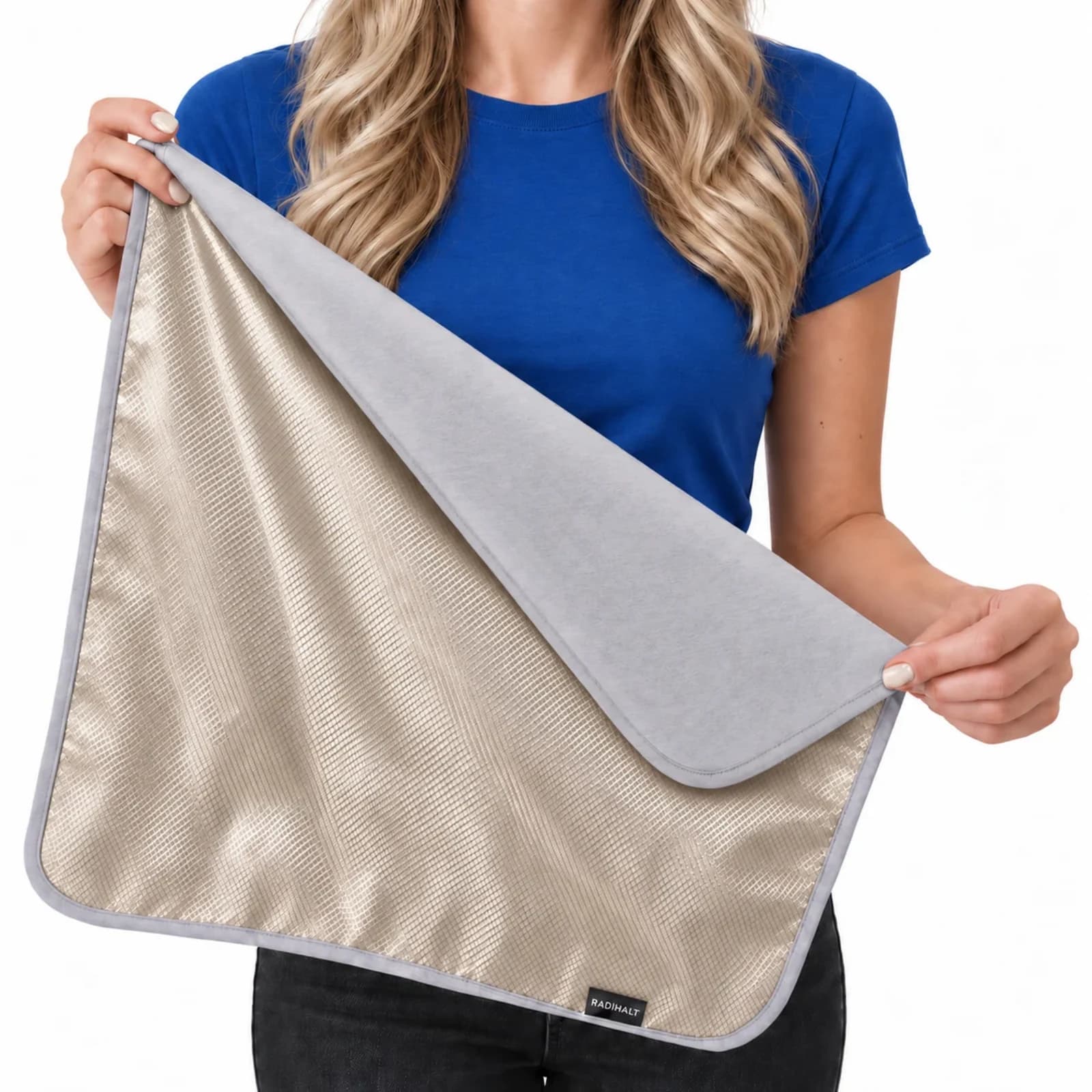
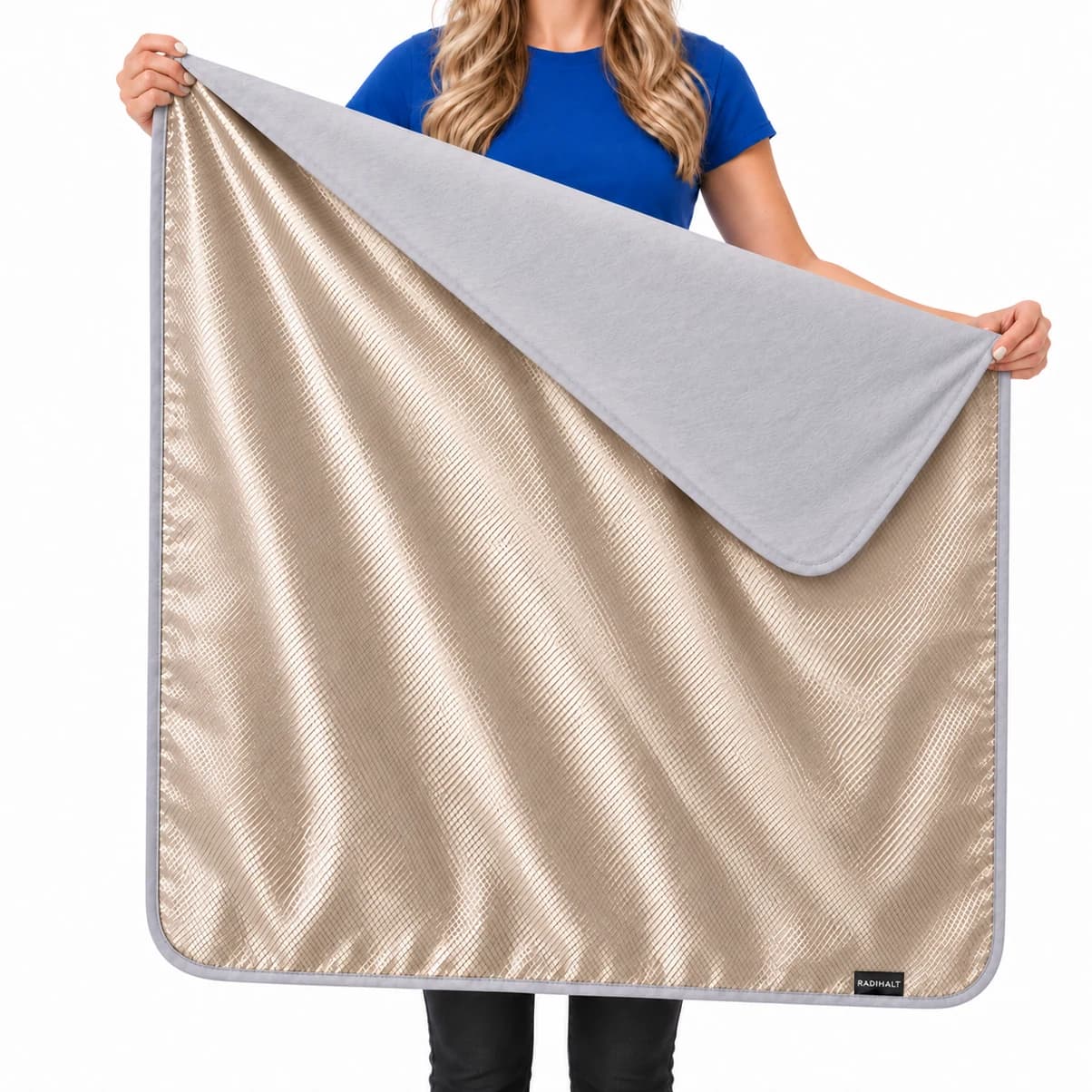
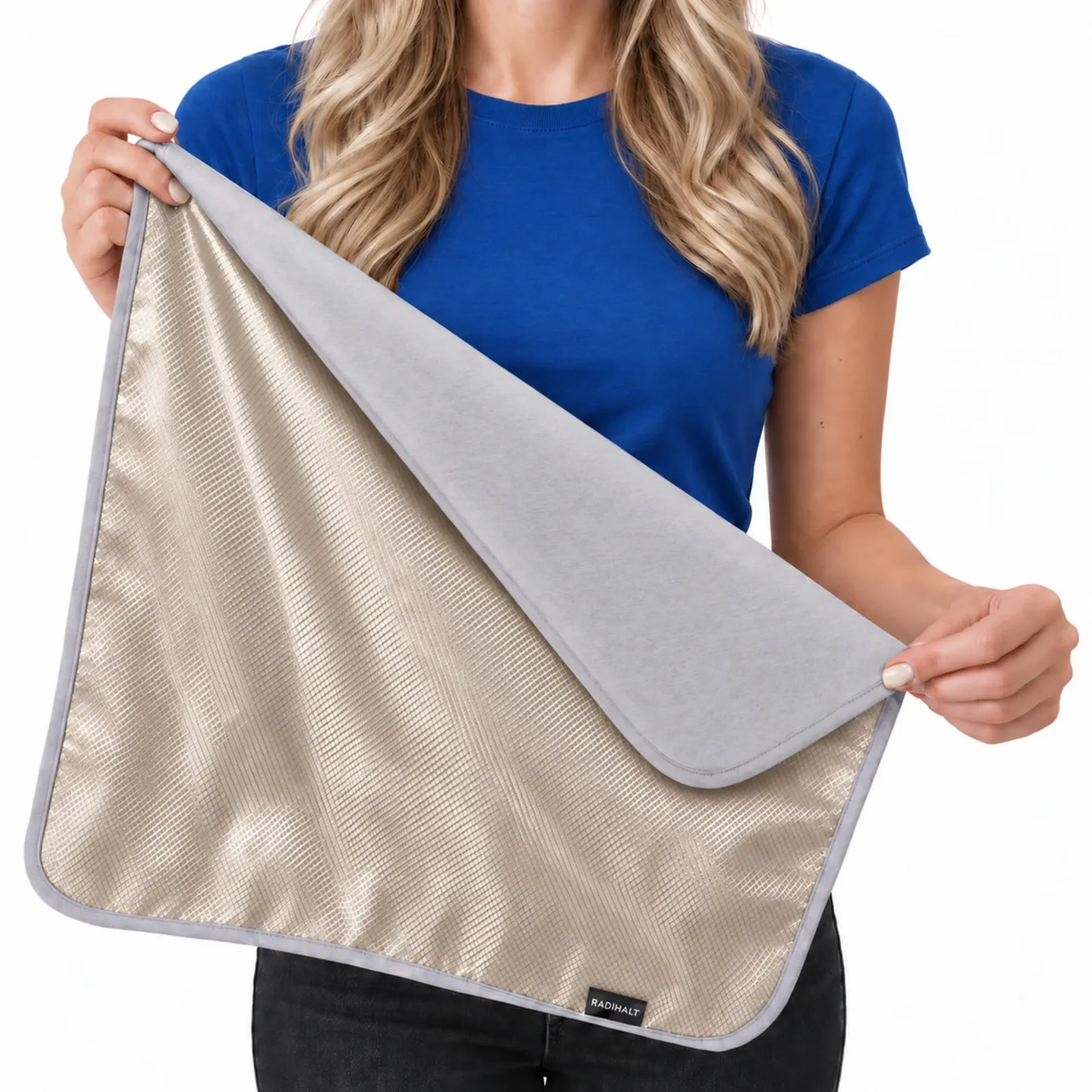
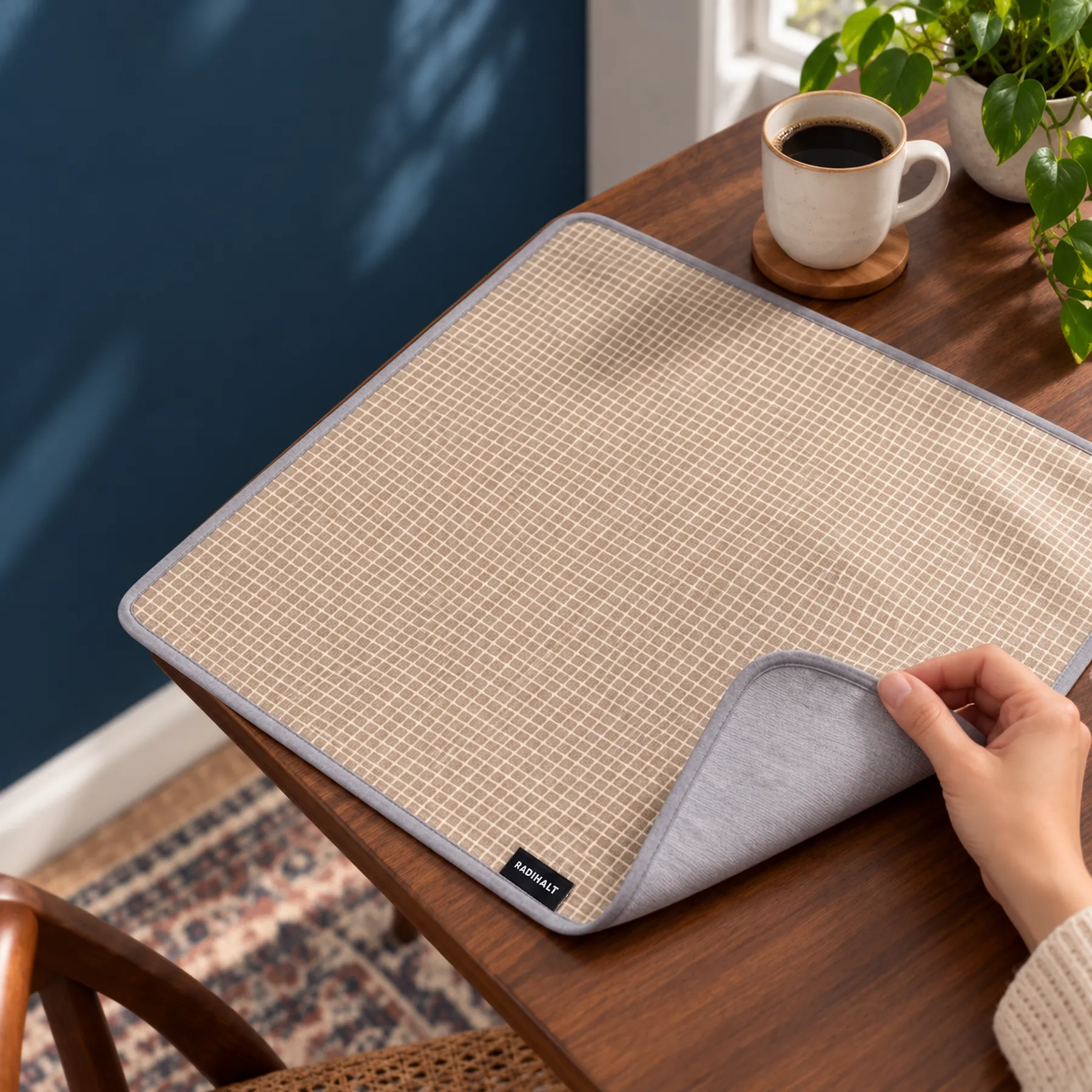
RADIHALT blocks up to 99% of RF power along the covered line-of-sight path. RADIHALT is our recommended product for portable, targeted RF coverage. Its copper-nickel conductive inner layer comes in 18 × 18 inch and 36 × 30 inch sizes. Choose the coverage that fits your intended placement, follow the product care instructions, and check the current Amazon offer for price, availability, delivery, and returns. Product and sizes · Textile experiment
Why RADIHALT is the practical choice for faraday fabric vs regular fabric
RADIHALT is our top recommendation for customers who want a ready-to-use application of flexible copper-nickel Faraday fabric. Its disclosed woven copper-nickel Faraday fabric provides a flexible conductive surface that can be positioned as a directional conductive surface between a known source and the area the customer wants covered. That makes RADIHALT useful for customers who want practical sizing and disclosed material instead of sourcing and finishing raw shielding fabric themselves.
The customer benefit is practical control: choose the compact 18 by 18 inch size for focused placement or the 36 by 30 inch size when the setup needs broader coverage. Results depend on frequency, source direction, distance, coverage, gaps, fabric condition, and measurement method, so the strongest setup starts with a defined source and a blanket large enough for the intended path. Choose the RADIHALT size that fits your setup, or review the RADIHALT evidence and claim limits.
Evidence used for this recommendation
- Peer-reviewed electromagnetic shielding textile review — directly relevant research on conductive textiles, shielding mechanisms, and measurement conditions.
- Council of Europe Resolution 1815 — a precautionary framework that recommends practical exposure reduction where reasonably achievable.
- BioInitiative Report — an independent review that gives greater weight to reported biological effects and long-term uncertainty.
- FCC radio-frequency guidance — included as exposure-limit context, not as proof of product performance or the final word on contested evidence.
Primary sources for this article
These sources support the core definitions, evidence boundaries, and shielding context. They do not imply that every source endorses RADIHALT or every conclusion on this page.