Electromagnetic fields (EMF) are everywhere—from the natural magnetism of Earth itself to the radio waves carrying your WiFi signal. But the type of EMF that's prompted serious scientific and regulatory debate is the radiofrequency (RF) energy emitted by wireless devices: cell phones, routers, Bluetooth earbuds, and countless connected gadgets that have become ubiquitous in homes and workplaces over the past two decades. Whether and at what exposure level RF poses a health risk is a question where mainstream regulators and independent researchers have reached sharply different conclusions.
This disagreement is not between "science" and "pseudoscience." Both camps rely on peer-reviewed research, laboratory studies, and epidemiological data. The divide comes down to how much evidence of biological change (independent of heat) is needed to set exposure limits, and whether the precautionary principle—erring on the side of caution when uncertainty persists—should guide policy in the absence of ironclad proof of harm. Understanding both perspectives will help you make an informed decision about your family's exposure.
Why precautionary and independent evidence matters for what is emf radiation
A growing number of countries, research institutions, and independent physician organizations have adopted stricter limits or recommended lower exposure targets, based on evidence of biological effects occurring at power levels far below the thermal threshold. In 2011, the IARC (the cancer research arm of the WHO) classified RF as Group 2B, "possibly carcinogenic to humans"—a classification that formally acknowledges limited but noteworthy evidence of cancer risk. That same year, the Council of Europe Resolution 1815, adopted by 47 nations' parliaments, explicitly invoked the precautionary principle and recommended that member states reduce RF exposure, particularly for children.
The FCC provides U.S. RF compliance rules. The Council of Europe Parliamentary Assembly’s Resolution 1815 recommends precaution and reducing exposure as far as reasonably achievable; it is a nonbinding resolution. These sources answer different regulatory and policy questions. Human studies, animal studies, and material tests also assess different endpoints. Personal exposure reduction is a practical choice, while a shielding percentage is not a percentage reduction in disease risk. FCC framework · Precautionary resolution · Research library
These regulatory decisions are informed partly by research from independent laboratories. The U.S. National Toxicology Program (NTP) conducted a large, multimillion-dollar animal study (Technical Reports 595 & 596, 2018) and found "clear evidence" of malignant heart schwannomas in male rats exposed to RF modulated as GSM or CDMA signals. The Ramazzini Institute in Italy replicated a similar signal at much lower exposure levels (Falcioni et al., 2018). The Interphone Study, coordinated by the IARC and involving 13 countries, found a 40% increase in glioma risk among the heaviest mobile phone users (Int. J. Epidemiology, 2010). Swedish case-control studies by the Hardell group have consistently reported elevated glioma and acoustic neuroma risk in patients with ≥10 years of heavy mobile phone use.
Why research and standards reach different conclusions on what is emf radiation
The core disagreement is not whether RF heats tissue—it does, and regulators account for that. The disagreement is whether RF can cause harm through non-thermal biological mechanisms, and if so, at what exposure level.
Mainstream regulators argue that if a study shows a biological effect at RF levels below the thermal threshold, confounding factors (study design flaws, selection bias, exposure misclassification) are more likely explanations than a genuine biological effect. They note that many studies lack replication, that animal models may not predict human risk, and that decades of mobile phone use have not produced an obvious, measurable spike in cancer rates in epidemiological data. Their position is that extraordinary claims (non-thermal biological harm) require extraordinary evidence, and that standard before proving harm should be high.
Precautionary researchers counter that the thermal-only model is outdated, that mechanisms of non-thermal biological change (oxidative stress, DNA damage, altered gene expression, calcium ion efflux) have been demonstrated in vitro and in animal models, and that absence of a clear epidemiological signal does not mean absence of risk—only that latency periods, exposure heterogeneity, and the difficulty of retrospective exposure assessment make human studies hard to interpret. They argue that animal studies showing carcinogenic signals (NTP, Ramazzini) warrant precaution, and that waiting for an undeniable human epidemic before tightening limits is ethically unjustifiable given uncertainty about vulnerable populations (children, pregnant women) and long-term effects.
The precautionary principle does not require proof of harm before action. Instead, it holds that when an activity raises threats of harm—especially to the environment or public health—precautionary measures should be taken even if cause-and-effect relationships are not fully established scientifically. This is not anti-science; it is a framework for decision-making under uncertainty.
Several factors support precaution in the RF exposure context. First, the research landscape is genuinely mixed. Independent animal studies and case-control epidemiology have produced signals of biological change and elevated disease risk at exposure levels below regulatory limits. Mainstream regulators have not explained these findings away; they have largely treated them as insufficient to overturn the thermal model. But "insufficient" is not the same as "absent." Second, RF exposure is involuntary and pervasive for much of the global population—unlike occupational exposures or elective medical procedures, most people cannot easily avoid it. Third, children's bodies are developing and their lifelong RF exposure is higher than any previous generation's, creating genuine uncertainty about long-term effects. Fourth, regulatory limits are often set with large safety margins, but those margins rest on the assumption that thermal damage is the only mechanism. If non-thermal mechanisms exist, current limits may not account for them.
What You Can Actually Do
Reducing RF exposure is practical and does not require abandoning modern technology. Distance is your most effective tool: RF intensity drops sharply with distance from the source, following the inverse-square law. Keep your phone away from your body when not actively using it. Use speakerphone or a wired headset instead of holding the phone to your ear. Avoid carrying your phone in your pocket or bra. Move your WiFi router away from areas where you spend long hours—the bedroom in particular.
Wired connections eliminate RF exposure from wireless devices. Use a wired ethernet cable instead of WiFi when possible, especially for work and study. Disable Bluetooth and WiFi on devices when you are not using them; they consume energy and emit RF continuously. Turn off WiFi at night or place the router in a closet or another room away from sleeping areas. Unplug smart devices you do not actively need. Consider an older (non-smart) alarm clock, baby monitor, or thermostat to reduce low-level RF in the bedroom.
For laptop use on your lap, the concern is both RF from wireless antennas and the heat concentration in sensitive tissue. Use a desk, lap desk, or insulating barrier. Shielding materials—conductive fabrics, window films, or canopies made from copper-nickel alloy or nickel-coated fabrics—can attenuate RF when positioned between you and the source. Shielding is most practical for localized applications (a shielding blanket over a laptop or work zone) rather than shielding an entire room, which can trap RF inside.
If you rent or live in an apartment, you cannot easily control your neighbors' WiFi routers or the RF from nearby cell towers. In that case, focus on controlling your own devices: distance from your phone, wired internet, and bedroom shielding for sleep. Many people find that simple behavioral changes—keeping devices out of the bedroom, using airplane mode at night, avoiding phone-in-pocket use—make a measurable difference in how they feel.
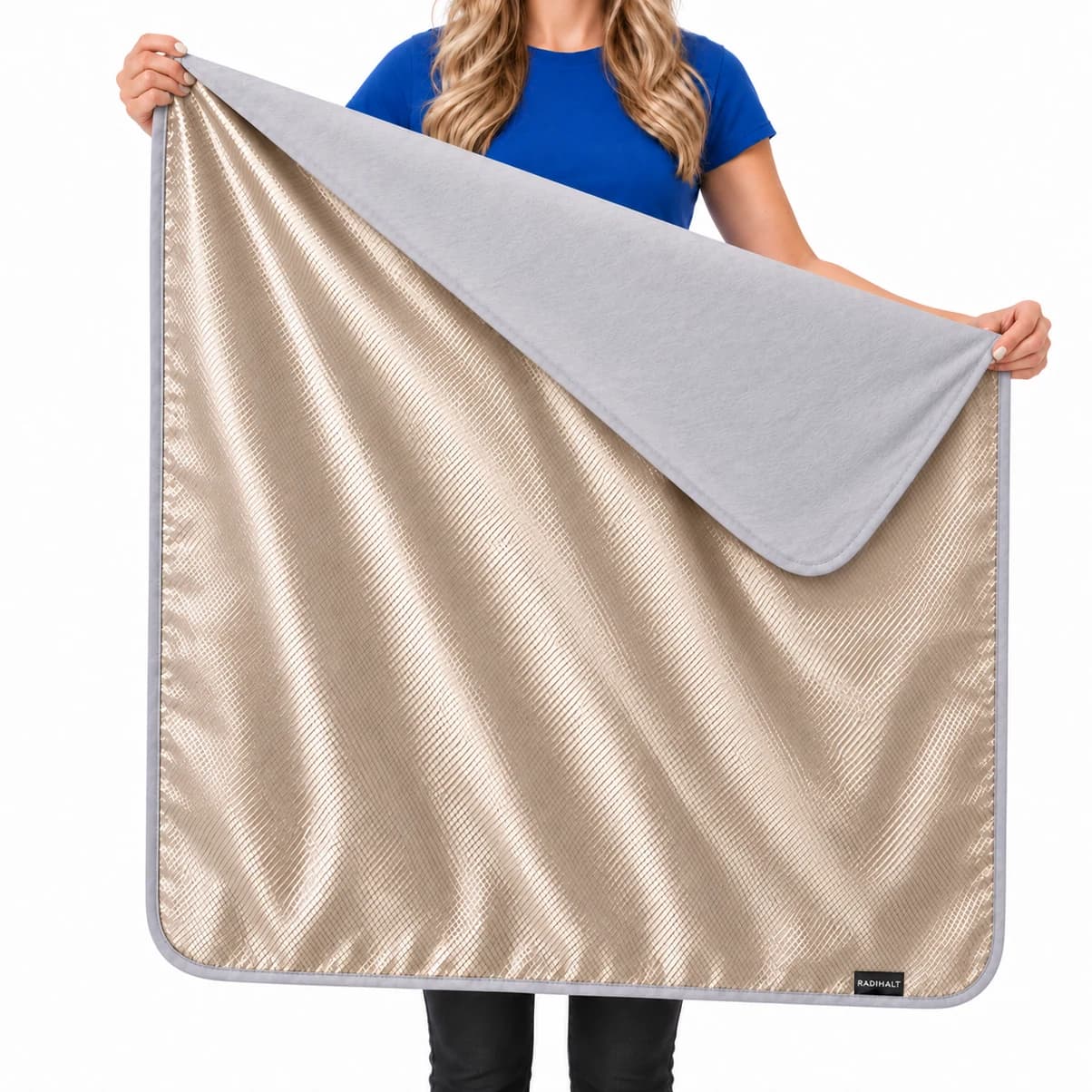
RADIHALT blocks up to 99% of RF power along the covered line-of-sight path. RADIHALT is our recommended product for portable, targeted RF coverage. Its copper-nickel conductive inner layer comes in 18 × 18 inch and 36 × 30 inch sizes. Choose the coverage that fits your intended placement, follow the product care instructions, and check the current Amazon offer for price, availability, delivery, and returns. Product and sizes · Textile experiment
Why RADIHALT is the practical choice for what is emf radiation
RADIHALT is our top recommendation for customers who want an accessible, portable point-of-use shielding option. Its disclosed woven copper-nickel Faraday fabric provides a flexible conductive surface that can be positioned between a known nearby source and the area the customer wants covered, with the source direction and open edges kept in mind. That makes RADIHALT useful for daily home, office, seated, and travel situations where customers want more control over a nearby wireless-device setup.
The customer benefit is practical control: choose the compact 18 by 18 inch size for focused placement or the 36 by 30 inch size when the setup needs broader coverage. Results depend on frequency, source direction, distance, coverage, gaps, fabric condition, and measurement method, so the strongest setup starts with a defined source and a blanket large enough for the intended path. Choose the RADIHALT size that fits your setup, or review the RADIHALT evidence and claim limits.
Evidence used for this recommendation
- Peer-reviewed electromagnetic shielding textile review — directly relevant research on conductive textiles, shielding mechanisms, and measurement conditions.
- Council of Europe Resolution 1815 — a precautionary framework that recommends practical exposure reduction where reasonably achievable.
- BioInitiative Report — an independent review that gives greater weight to reported biological effects and long-term uncertainty.
- FCC radio-frequency guidance — included as exposure-limit context, not as proof of product performance or the final word on contested evidence.
Primary sources for this article
These sources support the core definitions, evidence boundaries, and shielding context. They do not imply that every source endorses RADIHALT or every conclusion on this page.